

A word from the journeyman scribe: This is the second of three planned installments examining the Revolutionary history of Allentown, Upper Freehold and the surrounding area in honor of the 250th anniversary of these United States. My aim, as ordered by my Cornwallis-admiring Editor-for-Life, is to present a snapshot of some of the more interesting people, events and extraordinary contributions of our historic village during America’s War for Independence from the British crown.
To be clear: These short installments are mere glimpses into the past and are not complete histories. I have leaned most heavily upon the hard-won research of amateur and professional historians, many of whom dedicated their personal and professional lives to discovering and preserving our Revolutionary past.
Foremost among those historians is John Fabiano of Allentown Borough, co-author and editor of the book “Allen’s Town, New Jersey: A Crossroads of the American Revolution.” Fabiano served as executive director of the Monmouth County Historical Commission and is a past president of the Allentown Borough Historical Preservation Commission. In 2025, he received the Jane G. Clayton Award for his contributions to historic preservation.
John has acted as a recruited Virgil to my Dante and led me back into the past and through the smoke, heat and cannon fire, from the cramped, candlelit offices of a young, liberty-minded Allen’s Town lawyer named Brearley, who would play his own part in changing the course of the war and eventually have significant input in shaping the U.S. Constitution, to the horrific deep freeze of Christmas 1776 along the banks of the Delaware just north of Trenton.
There, on the other side, the supreme commander of the Continental forces stood with his most trusted advisers in the gloom, clutched in the maw of a wintry wrath. He must have felt the heavy press of eternity as he considered a dangerous and ill-advised plan to cross the river and march through the freezing blackness to Hessian-occupied Trenton.
The story would continue through the bloody battles of Princeton and Monmouth and back into the fields of Upper Freehold, nearly approaching the dark and dangerous wilds of the Pine Barrens, then haunted by gangs of thieves, marauders and Loyalist Tories with revenge on their minds and blood on their hands. Thanks, John.
Thanks also to Allentown’s beloved historian, artist and patriot Alice Wikoff, the 2020 winner of the Jane G. Clayton Award. Along with John and Alice, we cannot forget the immense contributions and fighting spirit of Ann Garrison, who, John insists, “did most of the heavy lifting for the book.”
Garrison also spent many years fighting for Allentown’s wild greenbelt, farmland preservation and more. I must also recognize historians Michael Adelberg, Thomas Pyle of Princeton and David Fowler, upon whose work I relied.
Finally, thank you to the librarians here in old Allen’s Town and, truth be told, throughout this nation, for they are the keepers of the flame.
II. The French and Indian War, 1753-1758: Allen’s Town spies a distinguished visitor. Now, let’s get back onto the Lower York Road and remember where we are and, more importantly, when.
The reader will recall, no doubt, that the Lower York Road originally followed old Lenape-Unami trails along two creeks. Doctor’s Creek led toward the rich countryside, bayshore and East Coast, while Indian Run connected the slowly expanding pre-Revolutionary communities of East and West Jersey.
Those communities included Perth Amboy, the capital of East Jersey, and Burlington, the capital of West Jersey. The road also offered a route, as both Gens. Washington and Cornwallis would recognize, from New York to that hotbed of colonial separatist audacity, Philadelphia.
Yet here we still linger, in the middle. Indeed, at the very crossroads of it all.
The last time you and I, reader, loitered here at the corner of Allen Street, now Main Street, and what would, just after the Revolution, become Thomas Paine Street, though in modern times it somehow was renamed the bland, milquetoast Church Street, the French and Indian War was still very much in play.
In February 1756, we would have seen on our streets 24-year-old Col. George Washington of the Virginia Regiment. He was accompanied by his aide-de-camp, Capt. George Mercer; Capt. Robert Stewart; and two servants.
Washington was fresh from the ill-fated Braddock campaign in the wilderness near present-day Pittsburgh. He distinguished himself during the retreat following the Battle of the Monongahela while also being blamed for initiating hostilities and mishandling what were meant to be negotiations with the French, who were aggressively occupying the Ohio River Valley.
With his military career in serious question, the disillusioned Washington was en route to Boston to seek an official royal commission. He faced undermining criticism from fickle and capricious superior British officers who defamed the provincial militia and, in history’s retrospective glass, the ambitious Virginian himself.
When he tarried here in Allen’s Town, Washington may have spent his hard-earned shillings in its shops and frequented one of its inns or taverns. He possibly stopped at the Flag, where the Presbyterian manse now stands, or at “Randle’s Tavern,” also known as the “Crown Inn,” where Woody’s Downtown Cafe now serves hungry customers.
After being rebuffed by the British brass, Washington, now a changed and more seasoned field officer, quit his military service to the crown, returned to Virginia and took up the life of a gentleman farmer.
In time, Washington turned those lessons in combat, military discipline and the internal workings of the British forces into valuable weapons for the cause of liberty. We must leave his story there for now, for nearly 10 years had passed.
III. The Stamp Act: Outrage, riot and a fuse of rebellion lit. It was the spring of 1765, and tensions between the occupying British forces and the hard-working citizens of places such as Allen’s Town, Bordentown, Burlington, Philadelphia and Boston were heating up.
The small village of Allen’s Town, a humble cluster of 80 or so mostly rustic structures punctuated by the occasional grander dwelling that was likely the home of a prosperous merchant with dealings elsewhere, seemed to find itself increasingly in the crosshairs of British aggression and unwarranted attention. Similar situations abounded in nearby hamlets. Pleas and letters to England for mercy and more reasonable taxation went unheeded and were even mocked.
British troops had begun harassing common citizens, farmers and small businesses alike, a dark foreshadowing of the violent housing and quartering of troops to come during the war proper.
Beyond the increasing taxes, little did the colonists realize, from Boston down to Georgia, that the worst was yet to come.
On March 22, 1765, Parliament passed the Stamp Act, and King George III granted it royal assent. The act imposed a new tax throughout the 13 American colonies, requiring every significant piece of paper, including pamphlets, playing cards and legal documents, to carry a royal tax stamp.
Due to reckless spending, unnecessary foreign excursions, years of war and the relentless expansion of the empire, the British were deeply in debt and needed to raise roughly 100,000 pounds per year for an indefinite period.
The stamp tax, the colonists were glibly told, would pay for British garrisons stationed there to “protect their lives and property.” From this affront arose the rallying cry “taxation without representation” among the irate citizenry.
Although Fabiano points out that the Stamp Act “primarily affected the upper echelons of colonial society” — merchants, lawyers, tavern owners and the like — it can be argued that the colonies were represented, if you will, by average working men and women who, while not wealthy, were already dreaming of bigger opportunities and hunting for better lives for themselves and their children.
In other words, America, even before formally declaring independence or creating a Constitution consisting of noble ideas, political and societal norms, and legal structures meant to create a society of laws, had perhaps already slipped the grasping bonds of a faraway king and his impecunious empire.
The colonists, led by angry merchants, journalists and other professionals, protested, rallied and rioted in the streets of small villages and large towns alike, forcing nearly all the stamp distributors to resign hastily.
Even more damaging to British authority was the nearly universal boycott of goods imported from England. Under extreme pressure from British merchants, the crown reluctantly repealed the Stamp Act in March 1766, but Parliament peevishly replaced it with the Declaratory Act, legislation explicitly stating that Parliament retained the absolute power to legislate and tax the colonies “in all cases whatsoever.”
This constant conflict over taxation and interference with the colonists’ day-to-day business would eventually set the stage for the War for Independence, with Allen’s Town squarely in the center of the gathering storm.
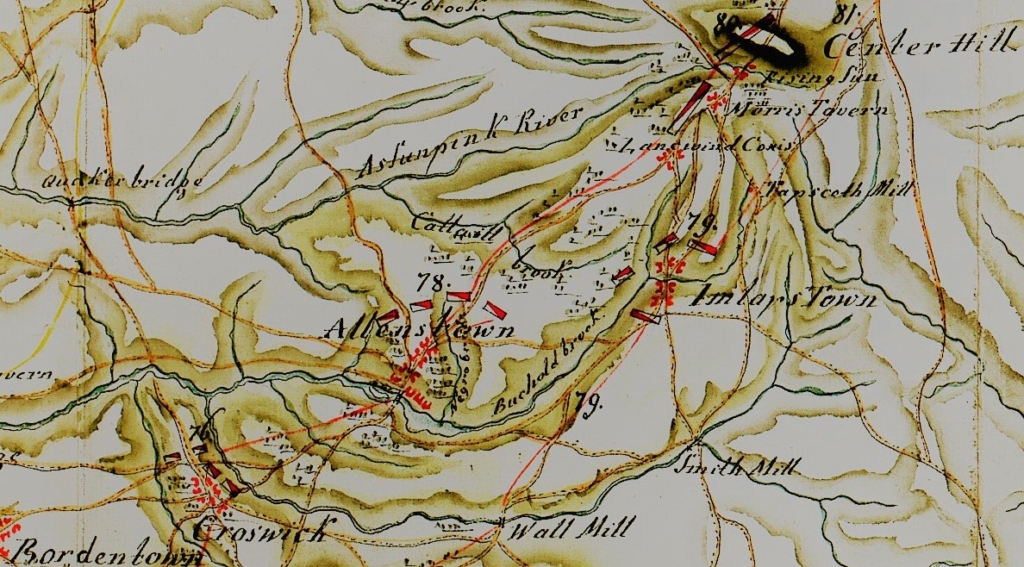
IV. Allen’s Town on the eve of revolution: Patriots, Tories and Pine Barrens Robbers. Garrison and Fabiano write in their 2001 treatise that, before the war, a network of closely connected, prominent businessmen controlled transportation along the Lower York Road.
They write that the road linked the two capitals of East and West Jersey, Burlington City and Perth Amboy, and continued to New York and Philadelphia.
“During these years, the Borden family, the Rogers family, the Kirkbride family, the Height family and the Brown family, among others, often intermarried, creating a tight kinship network that was to play a major role in the war of the revolution in New Jersey,” they write.
Thus, Allentown figured prominently as a crucial link in the network of places along this route where county quartermasters from Burlington, Monmouth and Middlesex counties were stationed. Garrison et al. note that some members of these important local families sacrificed their fortunes and their very lives to the cause of liberty.
One of Allen’s Town’s most prominent residents and noted Patriots, Samuel Rogers, stood out as a key figure during this time and as a central link in the transportation of people and goods from New York to Philadelphia.
Rogers used his transportation business fruitfully to build valuable and profitable relationships that would later become a lifeline for the American side. He was not alone in this effort, as it is well documented that the vast majority of farmers and businesses in Allen’s Town and Upper Freehold smuggled grain, wool, a variety of foodstuffs and even lead up to Boston when that important port city suffered its first blockade by the British in 1774 following the Boston Tea Party.
Yet the rebellious, busy little hamlet, with its molasses-processing facility, mills of every stripe, pork, access to salt works, rich and plentiful farms and more, cleverly and quietly provided Gen. George Washington, Alexander Hamilton, who was encamped here in Allen’s Town ahead of the Battle of Monmouth, Lafayette and other commanders with invaluable sustenance and aid throughout the war.
It is no small thing to say that these noble Allentown and Upper Freehold families often had their property and even their homes confiscated, ransacked or burned by the British and their Hessian thugs.
In the particularly notable case of Allen’s Town’s own Isaac Randolph family, the consequences of patriotism and assisting the war effort against the British occupation were dire indeed. Isaac Randolph was a partner in Samuel Rogers’ transportation business.
Isaac’s sons, the three young Patriot Randolph brothers, James, Benjamin and Daniel, all suffered attacks and grave mistreatment during the war, including kidnapping, torture, lengthy imprisonment and, in one case, execution.
Benjamin ran Randle’s Tavern, also known as the Crown, in Allen’s Town.
In 1782, Daniel Randolph was captured by British forces along with Capt. Joshua Huddy while guarding the salt works. He was tortured so badly at the Sugar House prison in New York that he lost both legs. Huddy was unceremoniously hanged by the British atop the coastal Highlands.
Unlike his brother James, who was unceremoniously and without explanation executed while a prisoner of a gang of Loyalists in New York, Benjamin Randolph survived the war.
Benjamin was the proprietor of the well-known Speedwell sawmill in the Pine Barrens and owned a shop that sold his famous and much sought-after fine Chippendale furniture. He went on to operate a Philadelphia tavern.
The tavern of note was called “The Sign of the Golden Eagle.” It was not far from Independence Hall and was well known and frequented by Benjamin Franklin, Martha and George Washington, Thomas Jefferson and other luminaries of the era.
Joseph Borden Jr. of Bordentown assumed control of the stage and boat line connecting Philadelphia and New York.
Borden later became a colonel in Washington’s Continental Army, while his son attained the rank of captain. Both were prominent officers in the American Revolution.
Because of its strategic location between Perth Amboy and Burlington, New York and Philadelphia, and so near the Pine Barrens route to the coastline, Allen’s Town was the perfect location for New Jersey’s Courts of Admiralty, Fabiano explained.
The courts met mainly at Randle’s Tavern, formerly Barton’s Tavern, which had been operated by Gilbert Barton. They sometimes met at the Brick Tavern, also known as “The Queen,” and at other locations as well.
These courts decided the ownership of British ships and cargo captured by American privateers. Privateering was the practice of privately owned ships being authorized by a government to attack and capture enemy vessels.
The Allen’s Town courts evaluated the captured ships, sold any valuable cargo and distributed the money to the privateers.
Garrison, Fabiano et al. also write about Joseph Height, proprietor of the Stage Boat Tavern, who later bought Allentown Mills.
“The Stage Boat Tavern was another colonial public house in Burlington, on the riverside of Delaware Avenue near the Bassnet Tavern, and became the starting and stopping place for stages bound for the Amboys,” they write. “The last colonial proprietor of the Stage Boat Tavern was Joseph Height. He changed the name temporarily to the Sign of the General Wolfe, in honor of the man who commanded at Quebec. That was before 1770, when it reverted to the old name.”
While we have previously touched on Allentown Patriot and jurist David Brearley Jr., a signer of the United States Constitution, a fierce soldier and a dynamic intellect, it should be said that his father, David Sr., of Maidenhead, now Lawrenceville, was jailed no fewer than twice for leading New Jersey’s anti-proprietary land riots in the 1740s, according to Garrison et al.
We know that the younger Brearley practiced law from his Allen’s Town home at 7 S. Main St. His home and offices were burned under suspicious circumstances in 1771.
Brearley served as a colonel in the Monmouth County militia and later attained the rank of lieutenant colonel in the Continental Army. He served until 1779, when he resigned his commission to become New Jersey’s chief justice.
From historian Thomas Pyle of Princeton and Mercer-Gothic Lodge No. 270 F&AM, we also learn that Brearley served as an important leader in the founding of Freemasonry in New Jersey.
The gallant Patriot, jurist, shaper and signer of the U.S. Constitution and chief justice was also New Jersey’s first grand master of the Grand Lodge. Like Washington, Franklin and other Founding Fathers, Brearley was committed to the expansion of the fraternity in the colonies.
As we speak of Patriots too numerous to name, even in a three-part newspaper series, we should note that New Jersey was the scene of more battles and skirmishes than any other colony.
Those conflicts included the battles of Trenton, Princeton and Monmouth, along with skirmishes in Crosswicks, Bordentown, Allen’s Town and communities along the coast. Allen’s Town was also the site of the vast majority of Admiralty cases, many of which were heard chiefly in Randle’s Tavern, formerly Barton’s, among other locations. These cases involved hearings of seafaring privateering cases away from the interference of British authorities.
A fourth tavern in Revolutionary-era Allen’s Town was the Cunningham Hotel, situated at 1 N. Main St. Shortly after the war, it became the Mason’s Crossed Arms and was owned and tended by Masonic leader Thomas Leland.
Just before the Civil War, the tavern and inn became known as the Union Hotel. Legend holds that during the Revolution, as the war seemed to turn in the Patriots’ favor, several Hessian soldiers hid in the basement of the Cunningham and eventually deserted.
I would be remiss if we did not touch upon two important, very different occurrences in Allen’s Town and Upper Freehold during the American Revolution.
The first is the legend of the Pine Barrens Robbers, a loosely affiliated gang of Tory thugs and masked ne’er-do-wells who met at Waln’s Mill in Upper Freehold and targeted Patriot farmers and travelers in Upper Freehold and the Pinelands near Jackson.
Allegedly led by a farmer named Woodward, Waln allowed the group to meet and scheme in a secret location on his sizable farm and forge.
One Tory of note was a fellow named Pearson, a virulent Loyalist potentially associated with the Pine Barrens Robbers.
The story goes that, following an impromptu raid on a meeting of Loyalists by the Delaware militia passing through Allen’s Town, Pearson was abandoned by his compatriots and sought to escape up the Lower York Road toward Hightstown. There, he was shot in the back while fleeing as a coward.
A second local tradition is that of Jinnie Jackson Waglum, an Upper Freehold woman who, many historians claim, led Washington’s troops after the Second Battle of Trenton.
Jackson Waglum was a young Irish immigrant whose father owned a large, prosperous 1,000-acre farm on Walnford Road. She is listed as a member of Allentown’s Presbyterian Church. Often referred to simply as “Jinnie Jackson,” she was nonetheless married and living not far from Trenton in Maidenhead, now Lawrenceville.
After hearing of Gen. Washington’s daring expedition on the night of Dec. 25-26, 1776, to cross the frozen Delaware River and march 10 miles through the bitter darkness to surprise the Hessians and British officers in Trenton, she was determined to offer her assistance.
As the British planned their retaliatory attack on Washington’s encampment at Trenton, Jinnie Jackson, the farm girl from Walnford Road, rode with the devil at her back to reach the commander in camp.
Washington reportedly accepted her unusual offer, and on Jan. 2, 1777, Jackson donned a soldier’s tricorn hat, a Patriot blue army jacket and a cast-off woolen cloak.
Under cover of night, she led the colonial troops through the dense, snowy forests to the site of the Battle of Princeton. They arrived on the morning of Jan. 3, 1777, and took advantageous ground in preparation for the bloody conflict to come.
To be continued next month.

