(Part III of Allentow ’s important and historic role in America’s fight for independence)
Religion played an important role in Allen’s Town and Upper Freehold as the colonies moved toward revolution.
In and around Allen’s Town, Hightstown, Millstone, Imlaystown, Crosswicks, Bordentown and Philadelphia lived a large population of prosperous, hard-working Quakers. The Quakers, or Society of Friends, opposed war, and from 1774 to 1778 the religious pacifists held conventions and issued statements directed at both British forces and their increasingly rebellious colonial neighbors. Their position was clear: They would do no violence to another living soul.
By the summer of 1776, however, as the colonies declared their independence from Great Britain, the Quaker community found itself at a difficult crossroads.
Five New Jersey representatives signed the Declaration of Independence: Richard Stockton, a prominent lawyer who was eventually captured and tortured by the British; John Witherspoon, a minister and president of the College of New Jersey, now Princeton University; Francis Hopkinson, a respected judge; John Hart, a farmer whose property was destroyed by British soldiers; and Abraham Clark, a lawyer known as a friend of common, less-affluent colonists.
Although the Quakers did not condone violence, even for the sake of establishing a new, united nation out of 13 separate colonies, they also did not relish being harassed, taxed into poverty or, worse, forced to take up arms by the ever-encroaching, ever-emboldened British occupiers. In fact, there were some well-known Quakers, the author, inventor and rebel philosopher Thomas Paine being one, who actively supported the growing revolution.
The first pastor of the Imlaystown Baptist Church, then called Upper Freehold Church and located where the “Old Yellow Meeting House” now stands, was the Rev. David Jones. Jones was born in Delaware in 1736, became a Baptist in 1758 and studied for the ministry with the Rev. Isaac Eaton in New Jersey and, specifically, with the Rev. Abel Morgan of Middletown. Jones preached occasionally at Freehold, Cranbury and Crosswicks. He was one of the constituent members of the Imlaystown church and was ordained as its first pastor in 1766.
In 1772, Jones went on a gospel mission to the Shawnee and Delaware Indians, an expedition he deemed successful, and he returned to the Imlaystown church, remaining until the American revolt was fully ignited. The good reverend was unapologetically patriotic and was so hated by the Tories of Monmouth that he fled Imlaystown in fear for his life and became pastor of the Great Valley Baptist Church in Chester County, Pennsylvania, in the spring of 1775. According to his biography, Jones preached a sermon titled “Defensive War is a Just Cause, Sinless,” before Lt. Col. William Dewees’ Continental Regiment in Pennsylvania during the celebration of the Continental Fast. The sermon was printed and widely distributed throughout the colonies.
In 1776, Jones was made chaplain to a Pennsylvania regiment under St. Clair at Ticonderoga, where a battle was imminent. He served in two campaigns under General Gates. He was with Wayne at the Battle of Brandywine and the Battle of Germantown. Chaplain Jones was at Whitemarsh and Valley Forge, with Continental Gen. Anthony Wayne at the Battle of Monmouth on June 28, 1778, and in significant campaigns through the surrender of Cornwallis at Yorktown, after which he returned home to his farm and church. He was so active that British Gen. William Howe once offered a reward for him. Seasoned British soldiers marched to Great Valley to arrest him but failed.
During this time, Imlaystown’s Jones, seeing a British trooper dismount and enter a house for refreshment, also noticed that the trooper’s pistols remained in the holsters of his saddle. Jones snuck up to the officer’s charge, stole the pistols, stormed the house and took the trooper prisoner. He forced the humiliated British officer to go with him to Wayne’s camp. Wayne reportedly “roared with laughter at the idea of his chaplain capturing a British dragoon.”
According to historian John Fabiano and co-authors Ann Garrison, Alice Wycoff and others, another often overlooked but notable Allen’s Town patriot of the pulpit was the Rev. Charles McKnight, who arrived in Allentown in 1740. “At the age of 27, came to New Jersey from Northern Ireland, (Scotch Irish) where, beginning in 1744, he served several Presbyterian parishes including Cranbury and Allen’s Town. There was a contest between the two congregations for his residence which was ended in 1756 by Rev. McKnight taking sole charge of the Presbyterian Church at Allentown.”
Fabiano and his co-authors write in their abbreviated history, *Allen’s Town, New Jersey: A Crossroads of the American Revolution, 1775-1783*, that in 1756, anti-British fervor was growing stronger in the Allen’s Town area. Mindful of Presbyterian parishioners of the church who were either unready or yet unwilling to challenge the colonial “status quo,” or those few who might still remain loyal to the crown, McKnight attempted to walk the middle path within his church. “Dissent and strife,” the Allentown historians say, “over his ‘neutral course’, however, was taking its toll. Finally, he was forced to resign in 1766 after church officers stormed his house like a riotous mob forbidding him to say prayers for the King of England.”
Fabiano and company note that for eight years after McKnight’s dismissal, the church had no settled pastor. Several others traveled to the small but prosperous village to give sermons at different times, although communion was usually conducted under the authority of the Rev. William Tennent, who traveled from the Free Hill Church at Freehold.
The Rev. Charles McKnight became a fervent revolutionary, was heroically wounded at the Battle of Princeton and eventually lost his life in the struggle for independence.
A turning point: The Battle of Trenton
In the frigid, snowbound winter of 1776, Gen. George Washington found himself in precarious straits, leading his discouraged, scarcely equipped, hungry, freezing colonial troops in a retreat across New Jersey to Pennsylvania from New York City, then under the control of the British, as was much of New Jersey and Rhode Island. The Continental Congress in Philadelphia became increasingly concerned that the Patriot capital would soon fall to the British as well. Washington, with Gen. Nathaniel Greene prepared to command the left flank, encamped near McConkey’s Ferry on the Pennsylvania side of the ice-choked, swollen Delaware, awaiting reinforcements.
Meanwhile, Gen. John Sullivan was racing down from New England with an additional 2,000 troops to assist in Washington’s daring plan to surprise the Hessians and British occupying Trenton. It was on this blisteringly cold Christmas night that Washington received a small package sent by messenger from Thomas Paine in Fort Lee, New Jersey. Inside the parcel, the commander of the Colonial forces found a pamphlet titled *The Crisis*, written by Paine to bolster the fading, downtrodden Patriots. It begins, “These are the times that try men’s souls. The summer soldier and the sunshine patriot will, in this Crisis, shrink from the service of his country; but he that stands it now, deserves the love and thanks of man and woman….” Washington read the small but uplifting treatise aloud to his troops as the storm of ice, wind, snow and freezing rain further delayed the dangerous crossing.
The Durham boats crossed back and forth through the wicked current until finally, a little after 4 a.m., the exhausted army was ready to move. The Patriots marched through woodlands, fields and country roads heavy with snow and ice. In a bold turn of events, the Americans surprised the Hessians and British at 8 a.m. and took Trenton back.
Thus, Washington once again found himself very close, a mere 10 miles, to the strategic crossroads that was Allen’s Town. On Jan. 2 and 3, the Americans again crossed the Delaware and again defeated the British, who had sent for reinforcements and, Washington suspected, were re-forming for a counterattack. This second Battle of Trenton briefly interrupted the army’s advance on Princeton and Cornwallis and is also sometimes referred to as the “Battle of Assunpink Creek.” The Continental Army faced some 8,000 British and Hessian troops under General Cornwallis. The Continentals repelled Cornwallis’ attacks along Assunpink Creek until nightfall. As an early winter indigo dusk fell over the land, Cornwallis famously boasted that he would “bag the fox in the morning.”
Victory at Princeton
Washington had his troops light campfires in Trenton and then stealthily led them out of the city and around Cornwallis’ rear guard in an overnight gambit. The feint worked, and the Continental Army arrived in Princeton, with the help of Upper Freehold’s now-legendary guide and farm-girl soldier, Jinny Jackson, in prime position to potentially outfox the confident Cornwallis. On Jan. 3, 1777, the battle began with a sudden clash when American Gen. Hugh Mercer’s vanguard unexpectedly met the British 17th Foot Brigade, operating under the command of Lt. Col. Charles Mawhood.
It was in this initial skirmish that the heroic Mercer was fatally bludgeoned and bayoneted no fewer than seven times, although he languished in agony in the Thomas Clark House for nine days before finally succumbing to his grievous wounds. After Mercer’s horse was shot out from under him, the rebel commander found himself surrounded by British soldiers who ordered him to surrender. Mercer refused to yield and charged into the fray that would be his brutal undoing. After some initial confusion and the start of a retreat among the Continental ranks, the fallen general’s men rallied while, in short order, Washington charged to the front lines and met the surprised British regulars head-on in the open field, forcing their immediate retreat.
The Americans chased Cornwallis’ running regulars into the town of Princeton proper and onto the lawns of the College of New Jersey, now Princeton University, and there discovered some 200 British sheltering in Princeton’s Nassau Hall, which Alexander Hamilton promptly shelled with ready artillery. Legend has it that one of Hamilton’s cannonballs rammed through a large portrait of King George II as it tore through the walls of the hallowed main structure. All 200 British were reportedly captured by Hamilton and taken as prisoners of war.
A moral victory at Monmouth Courthouse
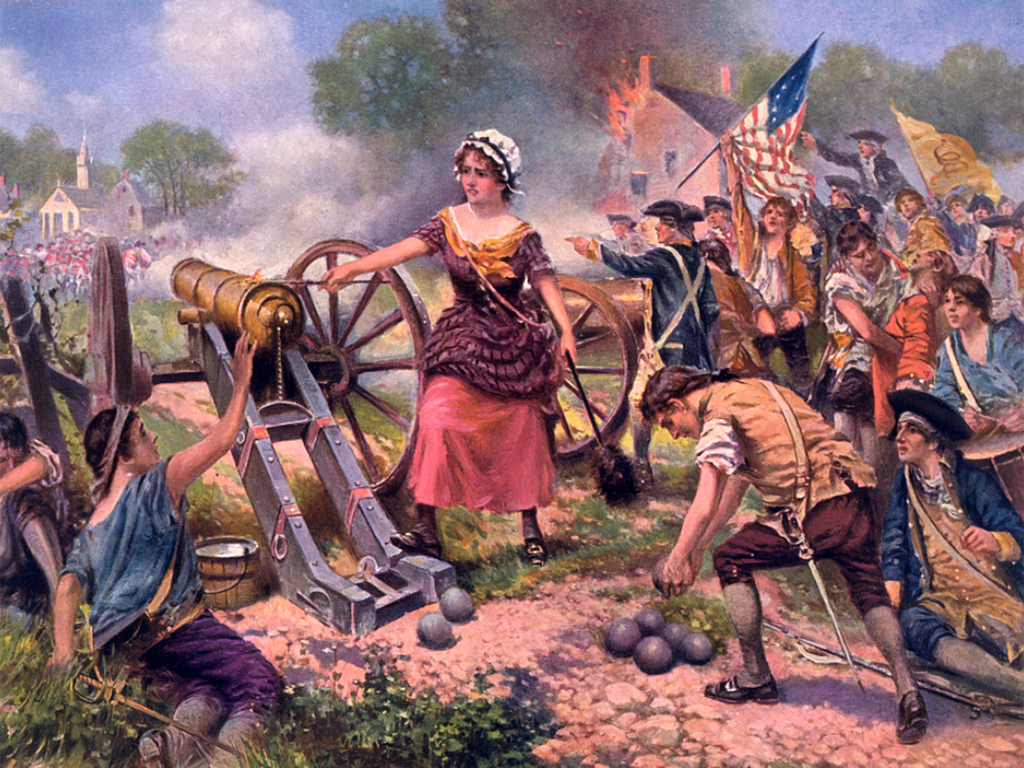
The Battle of Monmouth, also known as the Battle of Monmouth Court House, was fought near the village of Monmouth Court House in modern-day Freehold Borough and Manalapan, New Jersey, on June 28, 1778, during the American fight for independence. It pitted Washington’s army against the British, commanded by Gen. Sir Henry Clinton.
It was the last battle of the “Philadelphia campaign,” begun the previous year, during which the British had inflicted two major defeats on Washington and occupied Philadelphia. Washington had spent the winter at Valley Forge rebuilding his army and defending his position against political enemies who favored his replacement as commander in chief.
In February 1778, the French-American “Treaty of Alliance” swung the strategic balance in favor of the Americans, forcing the British to abandon hopes of an outright military victory and adopt a defensive strategy. Clinton was then ordered to evacuate Philadelphia and consolidate his army. The Continental Army stalked the British as they marched across New Jersey to Sandy Hook. Once there, Clinton hoped, the Royal Navy would ferry them to New York.
Washington’s war council urged caution, but the Continental commander understood that he could not allow the British to withdraw unscathed now that he had some advantage. Washington placed roughly a third of his army under the command of Maj. Gen. Charles Lee, hoping to send a stinging lash to his foes without entering yet another large skirmish.
Things did not go as planned, however, and the row went sour for Lee and his troops when he ordered a poorly planned attack on an entrenched British covering party at Briar Hill, just off Freehold. A counterattack by the main British rear guard, consisting of the First Division commanded by Cornwallis, forced Lee to retreat until Washington arrived with the main body. Clinton then fell back when he found Washington in an advantageous defensive position and resumed the march to Sandy Hook.
Clinton had previously divided his army into two divisions for the march from Philadelphia. Most of the combat troops were concentrated in the first division, while the second comprised most of the heavy transport of a 1,500-wagon baggage train. The British were harassed by increasingly strong American forces as they traversed New Jersey, and by June 27, 1778, Lee’s vanguard was within striking distance. When the British left Monmouth Court House the next day, Lee attempted his failed strike. Outnumbered, Lee was forced to retreat.
Although clumsy, the fierce skirmish had drawn the enemy out into an open field of combat and gave Washington enough time to deploy the main body of his army. Infantry clashes morphed into a two-hour artillery duel, during which Clinton began to fall back. The conflict finally ended when a Continental brigade established artillery on a hill overlooking the British lines. Seizing the moment, Washington launched two small guerrilla-style attacks on Clinton’s infantry as they withdrew, inflicting heavy casualties on the British in his second go.
Once again, darkness swept across the bloody field and brought the still-undecided battle to a halt. The two armies settled down within 1 mile of each other. The British slipped away unnoticed during the night to link up with the baggage train. The rest of the march to Sandy Hook was completed without further incident, and Clinton’s army was ferried to New York in early July.
On June 15, the British began to withdraw from Philadelphia, crossing the Delaware River into New Jersey. The last troops crossed three days later and camped at Haddonfield. Gen. Clinton, who had not yet decided on the exact route to New York, approximately 90 miles away, divided his army into two divisions and set out for Allentown, some 40 miles to the northeast. He accompanied the first division, which comprised some 10,000 troops under the command of Lt. Gen. Charles Lord Cornwallis. The second division, commanded by Lt. Gen. Wilhelm von Knyphausen, comprised just over 9,000 personnel, of whom more than 7,500 were combatants. This division contained the bulk of the slow-moving, heavy and therefore vulnerable transport of the 1,500-wagon baggage train. (Fabiano et al.)
Due to a brutal July heat wave, the entire march was conducted in short segments, which further slowed progress as troops suffered from heatstroke. The frequent sniping and skirmishing of Maxwell’s Continentals and Dickinson’s militia, and their attempts to obstruct and hinder the British by blocking roads, destroying bridges and spoiling wells, did not materially impede progress. Nonetheless, on June 24, the first division arrived at Allentown while the second reached Imlaystown, 4 miles (6 kilometers) to the east.[42] Clinton decided to head for Sandy Hook.
The next day, June 26, the British suffered almost 40 casualties in near-constant skirmishing in which one unit came close to being overrun. Knyphausen reached Monmouth Court House early that morning, and by 10 a.m. the entire column had concentrated there. It was clear to Clinton that Washington’s forces were gathering in numbers, and the British were exhausted after their 67-mile march from Philadelphia. Monmouth Court House offered a good defensive position, and it is possible that Clinton saw an opportunity for the battle he desired. He deployed his army to cover all approaches and decided to rest his troops for the next two nights. The bulk of his force, the first division, was deployed on the Allentown road, covering the second division in the village itself.
The revolution had precipitated a vicious civil war in Monmouth County that did credit to neither side and would continue after the armies had departed. It was fought between Patriots, who sided with the rebellion, and Loyalists, who remained loyal to Great Britain and even formed units, such as the Queen’s American Rangers, which fought alongside the British Army. The two sides also fought each other in the local political arena, and it is estimated that 50% of Monmouth County families suffered significant harm to person or property during the war. By spring 1778, the formerly Loyalist Monmouth Court House had come under Patriot control.
Clinton’s orders against pillaging were ignored by the rank and file and went unenforced by the officers. British and Hessian soldiers acting out of frustration and anger, and Loyalists acting out of vengeance, committed numerous acts of vandalism, looting and arson. By the time Clinton resumed the march on June 28, several of Allen’s Town’s buildings and homes had been damaged or destroyed, all of them Patriot-owned.
The end of war. The start of a new nation
Cornwallis unceremoniously and without honor surrendered after the Battle of Yorktown in Virginia.
The U.S. Constitution was signed on Sept. 17, 1787, and ratified on June 21, 1788, after New Hampshire became the ninth state. On March 4, 1789, the new federal government of the United States of America began operations, freed of its former shackles to Great Britain.
On Feb. 4, 1789, His Excellency General George Washington was elected president of the new democratic republic by a unanimous vote of the Electoral College. At his insistence that the president of the United States should be a servant of the people, he would be the last to bear the title of Excellency. John Adams, our second president, happily agreed that “Mister President” was sufficient.