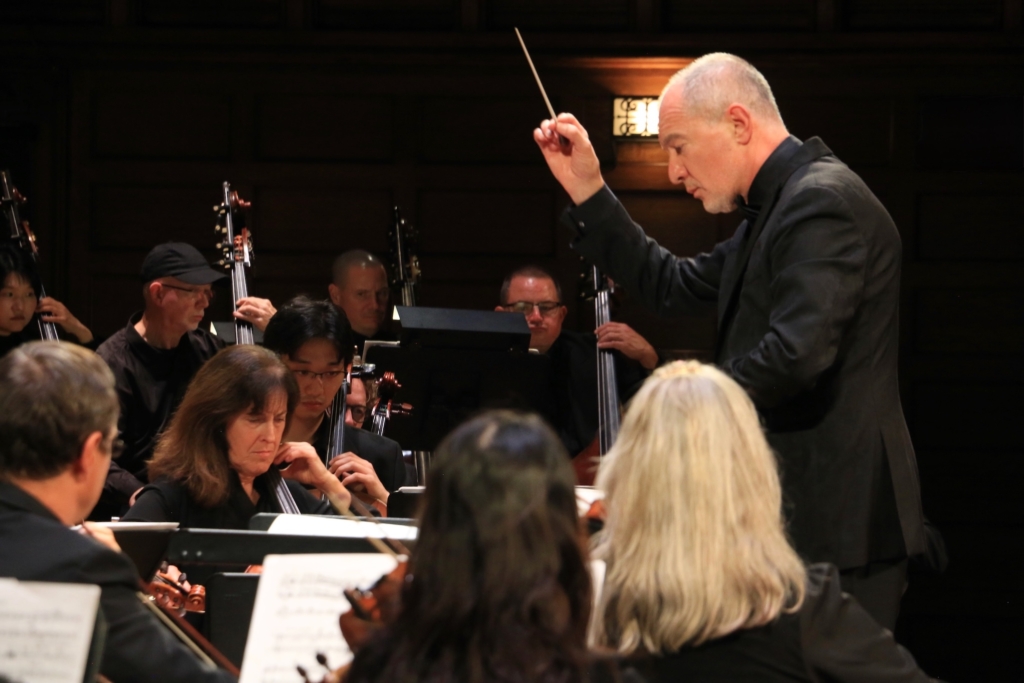
The Princeton Symphony Orchestra, conducted by music director Rossen Milanov, launched its 2026-27 season Saturday, October 17, with a program of all 20th-century music by composers Joan Tower, Sergei Rachmaninoff and Béla Bartók.
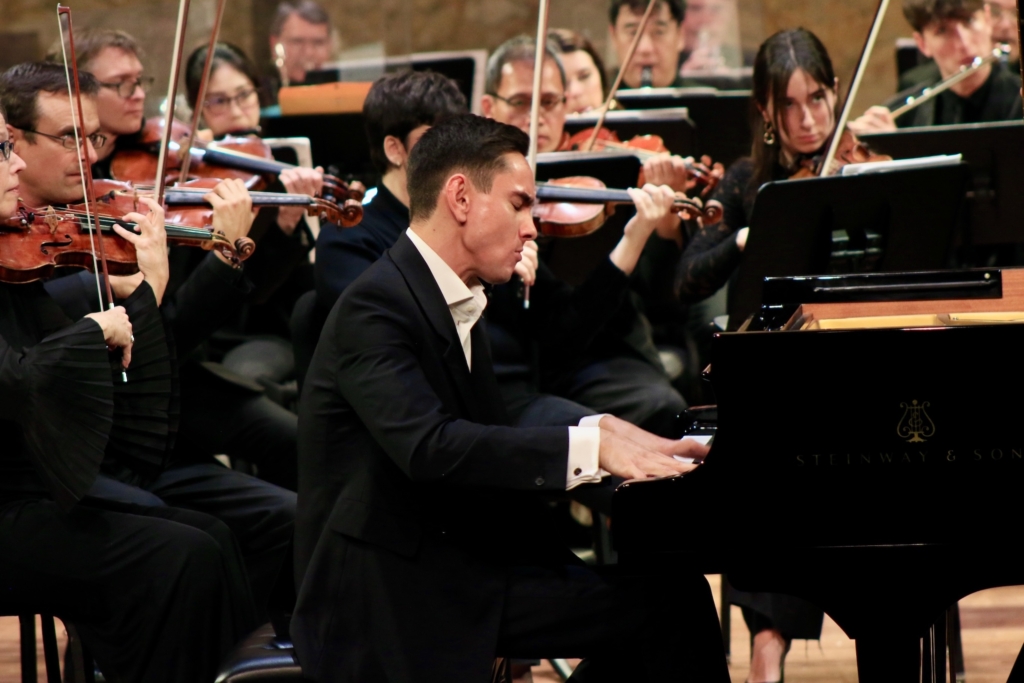
The centerpiece of the concert was a dazzling performance of Rachmaninoff’s “Rhapsody on a Theme of Paganini,” Op. 43, played by renowned Russian pianist Dmitry Shishkin.
But first, we heard the “Suite from Concerto for Orchestra” (1991) by Tower. The composer spent formative years in Bolivia, where her father was a mining engineer, and has said her time in South America sparked an interest in Latin American rhythms. We could hear elements of this in the suite, particularly in the percussion section, from gong to woodblocks to marimba to snare drum.
The composition challenged the entire orchestra, but especially the skills of the principal players. Clarinetist Pascal Archer and oboist Lillian Copeland skillfully explored the various registers of their respective instruments, with fine intonation.
The PSO adeptly executed Tower’s interplay between scales, dynamics, diverse tempos and difficult solos layered within a cinematic expressionism.
Rachmaninoff’s “Rhapsody on a Theme of Paganini” (1934) transferred the frenzied solo violin work of the legendary Niccolò Paganini to the piano. The piece was premiered by the Philadelphia Orchestra, led by Leopold Stokowski, with the composer as soloist. Interestingly, its first recording was made with Rachmaninoff and the “Philadelphians” at RCA Victor’s Trinity Church Studio in Camden.
The work began quietly, with the bare bones of the theme quickly evolving into something akin to a dance around the keyboard. The slender, youthful Shishkin conveyed little emotion in his face, but his hands were full of passion and almost attacked the piano in the next variation, with the lower brass joining in. Bright, tinkling tonalities from the flutes and percussion balanced this blast of sound.
Throughout the next handful of variations, we heard melancholy, muted strings and melodies passed between the clarinet and French horn, with the harp steadily strumming underneath it all. The brass took us on a rather martial journey as Shishkin and his focused hands ran up and down the piano with sheer fluidity and utter brilliance.
The first violin introduced a gentle line, picked up by the clarinet and French horn, while the soloist calmly played. This elegant 18th variation (which Rachmaninoff humorously said was for his agent) will sound familiar to many, especially those who remember its use in the 1980 film “Somewhere in Time.”
As Shishkin’s solo playing shimmered, the full orchestra soared above, showcasing the rich grandeur of Rachmaninoff.
The next few variations had the strings buzzing while the soloist explored the keyboard’s higher notes. The piece hurried toward its conclusion with jolting key changes, more martial-sounding passages and arpeggios. A final, breathtaking piano cadenza ended the rhapsody with a bang.
Many in the audience were at the concert expressly to see and hear Shishkin, and the soloist received enthusiastic applause, enough to return to the stage for two encores: another piece by Rachmaninoff, from his “13 Preludes,” and an etude by Prokofiev. I heard someone behind me say to his friend, “simply incredible.”
Bartók is sometimes called the “Father of Ethnomusicology,” and for decades before arriving in the United States, he had devoted his career to transcribing folk music from rural villages across Eastern Europe and even North Africa.
He wanted to absorb these ethnic sounds from other cultures to weave them into his own compositions. We heard many examples of these unusual sonic textures and elements in Bartók’s “Concerto for Orchestra” (1943).
The brooding opening is actually a quote from Bartók’s opera “Bluebeard’s Castle,” with the strings sounding like eerie, disembodied voices.
Lovely flute and oboe solos rose above the darker sounds as the movement evolved into a dirgelike melody. It was easy to hear the Eastern European elements, such as peasant scales or modes.
The second movement is like a survey of the orchestra, with the individual instruments introduced by a drum. It started with oboes, clarinets and flutes and spread through muted trumpets, lower brass and bassoons. All in all, it presented the PSO’s many talented soloists, particularly in the wind section.
“Elegia: Andante non troppo” was the central third movement, which Bartók wrote to evoke a mysterious countryside by night. Glissandi and rapid arpeggios brought rustling leaves to mind, while a solo piccolo represented a lone bird and its mournful sound.
The movement’s melancholy main theme, inspired by Transylvanian funeral music, was first heard in the violas, then circulated around the orchestra.
In the fourth movement, Bartók wanted to contrast the hopelessness of free people when pitted against authoritarian politics and violence, which was happening in his native Hungary.
To accomplish this, the composer wrote a hopeful melody (played by the oboe d’amore) to represent an idealistic youth serenading his love. This winsome sound was interrupted by sneering brass and an almost comical trombone snort and slide, representing the vulgar mob.
We were jolted by the timpani and basses kicking off the final movement. The ensemble jumped into the fast-paced music, which had a dancelike quality.
Percussion led into a softer section before a reappearance of the opening theme. The bassoon soared above ghostlike strings before the full orchestra returned to a grandiose finale.
The PSO took us on a splendid journey through an orchestral masterpiece.
Rossen Milanov conducted the Princeton Symphony Orchestra’s opening concert Saturday, October 17, with pianist Dmitry Shishkin. The next PSO concerts are scheduled for Saturday, November 14, and Sunday, November 15, and feature works by Fanny Mendelssohn Hensel and Joseph Haydn. Simone Porter will perform W.A. Mozart’s Violin Concerto No. 5, “Turkish.” Call (609) 497-0020 or visit www.princetonsymphony.org.