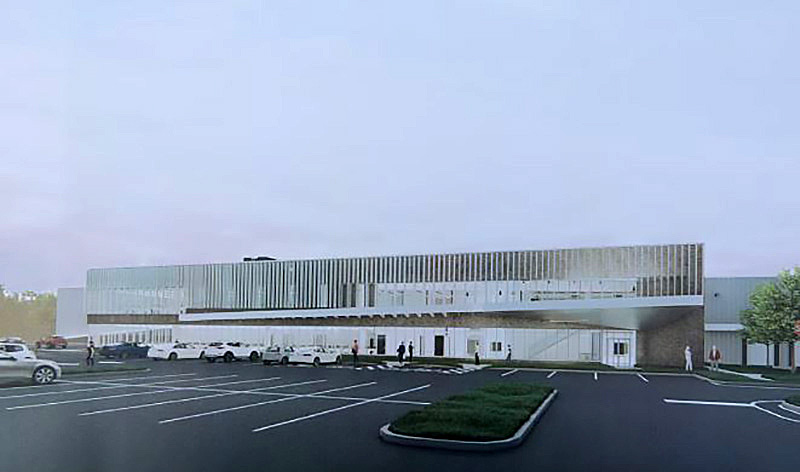
Federal and state lawmakers are calling on New Jersey environmental regulators to halt or reject an air pollution permit for a data center under construction in South Brunswick, citing potential health risks to residents of neighboring communities.
U.S. Rep. Bonnie Watson Coleman, state Sen. Andrew Zwicker and Assemblywoman Tennille McCoy announced their opposition Monday, Nov. 9, the final day for public comments on the proposed permit before the New Jersey Department of Environmental Protection.
Watson Coleman and Zwicker sent a joint letter to DEP Commissioner Ed Potosnak requesting that the state pause the permitting process until questions about the facility’s diesel-powered generators, potential emissions and public health effects are addressed.
McCoy, whose 14th Legislative District includes neighboring Plainsboro, separately called on DEP to deny the permit, saying residents of her district could be affected by a project approved in another municipality.
The permit concerns the Sentinel Princeton Nurseries Data Center, a 341,000-square-foot facility under construction at 4405 Route 1 on the former Princeton Nurseries property, just across the municipal boundary from Plainsboro.
“Air doesn’t stop at a township line,” McCoy said. “Plainsboro families will breathe what this facility emits, yet Plainsboro had no seat at the table when the project was approved. Before a single generator is permitted to run, NJDEP should offer our residents a full, transparent accounting of what this facility will put into our air.”
The draft permit, identified by the state as PN-DC1, covers 12 diesel-powered emergency generators, each rated at 3,620 kilowatts. The generators would provide backup electricity when the facility’s primary power supply is unavailable.
In their letter, dated Nov. 2 and announced Nov. 9, Watson Coleman and Zwicker questioned whether DEP’s environmental review adequately accounts for the generators’ potential emissions, particularly during extended power outages or other emergency operations.
The draft permit limits routine testing and maintenance to 28 hours annually per generator, but does not impose the same limit on qualifying emergency operation.
The lawmakers asked DEP to recalculate the facility’s potential emissions using at least 500 hours of operation per generator or explain why a lower figure would be appropriate and enforceable.
They also questioned why the permit covers 12 generators when public statements and reports have referred to plans for as many as 20 at the site.
The lawmakers want DEP to determine whether the full planned development should be classified as a major source of air pollution rather than a minor source, a distinction that affects the permitting requirements.
They also requested public disclosure of the data used in DEP’s health risk assessment, including how the analysis accounted for nearby homes, schools, existing pollution, weather conditions and the possibility of multiple generators operating simultaneously.
DEP has said its assessment found the health risk associated with the proposed generators to be negligible under state technical standards.
Watson Coleman and Zwicker said the department should independently verify the analysis, establish enforceable operating restrictions and allow another opportunity for public comment before issuing a final decision.
“We respectfully request that DEP not issue the permit in its current form,” the lawmakers wrote.
“We are asking for a complete, transparent review that protects public health and gives residents confidence that the law will be enforced.”
The letter also calls for an examination of cleaner backup power alternatives, including lower-emission generators, pollution controls and battery storage systems.
Pollutants associated with diesel exhaust include nitrogen oxides, benzene and formaldehyde. Residents and environmental advocates have also raised concerns about approximately 400,000 gallons of diesel fuel reportedly planned for storage at the site, along with the potential effects of generator testing and emergency operation on surrounding neighborhoods.
McCoy said the proximity of the data center to a major residential development planned in Plainsboro makes the potential environmental effects particularly important.
In June 2025, the Plainsboro Planning Board approved a mixed-use development on approximately 109 acres of the former Princeton Nurseries property, immediately south of the data center site.
That project includes 950 residential units, including apartments, townhouses, single-family homes and senior housing, along with a 75,000-square-foot hotel and nearly 320,000 square feet of commercial space.
McCoy said existing and future Plainsboro residents could be exposed to emissions, noise and other effects associated with the neighboring data center.
“We are asking residents to make a home on one side of this property line and asking them to accept an industrial power plant’s worth of diesel generators on the other,” McCoy said.
The latest statements add to growing opposition to the project from neighboring communities.
On Oct. 1, Princeton Mayor Mark Freda and the Princeton Council urged DEP to deny the permit in its present form, raising concerns about diesel emissions affecting residential neighborhoods and two elementary schools.
Zwicker and Assembly members Roy Freiman and Mitchelle Drulis, who represent the neighboring 16th Legislative District, previously requested additional time for public comments.
The DEP subsequently extended the original Oct. 7 deadline to Nov. 9. Approximately 200 people attended a Sept. 23 public hearing at the Princeton Marriott at Forrestal in Plainsboro, with about 30 offering testimony, according to the lawmakers.
The state permit proceeding is separate from the municipal land-use approvals already granted by South Brunswick. The township approved the data center in May 2025, and construction is continuing despite opposition and a legal challenge to the redevelopment process.
Watson Coleman and Zwicker acknowledged that data centers play an important role in the economy but said their increasing size and demand for electricity require closer examination.
Watson Coleman has introduced the Data Center Community Impact Act, which would authorize a federal study of the environmental, economic and public health effects of data centers, with particular attention to low-income communities and communities of color.
She is also an original co-sponsor of the federal AI Data Center Moratorium Act.
Zwicker is a primary sponsor of state legislation, S4659, that would require DEP to study the environmental and infrastructure effects of data center development and prohibit construction of new facilities until the study is completed.
The proposed state moratorium would exempt projects already approved or under construction when the legislation takes effect.
McCoy also pointed to recent state actions addressing the growing data center industry.
In July, Gov. Mikie Sherrill signed legislation creating a separate utility rate class for large data centers, intended to prevent the facilities’ electricity and infrastructure costs from being shifted to other customers.
In August, Sherrill signed another law requiring data center operators to report their energy and water consumption to the New Jersey Board of Public Utilities twice annually.
The following month, DEP announced a $1.07 million penalty against a Vineland data center after inspectors found 62 large natural-gas generators installed and operating without the required air permits.
Watson Coleman and Zwicker cited that enforcement action, along with a September diesel spill at an Equinix data center in Secaucus, as examples of why they believe backup power systems require additional scrutiny.
The Vineland enforcement action is unrelated to the South Brunswick project, which is undergoing the state’s air permitting process.
“These laws are a good start, but they don’t change the fact that this facility is already rising along Route 1,” McCoy said. “I will continue working with my colleagues in the Legislature, local officials and neighbors to make sure Plainsboro’s voice is heard.”
The DEP has not announced a date for its final decision on the Sentinel permit. The agency is expected to review testimony from the September hearing and written comments submitted during the public-comment period before making its determination.
Residents can submit comments through the DEP’s online form at dep.nj.gov/boss/permit-comment-form. Comments must be received by today and should reference facility PN-DC1, Program Interest Number 19525 and Permit Activity Number PCP250001.