

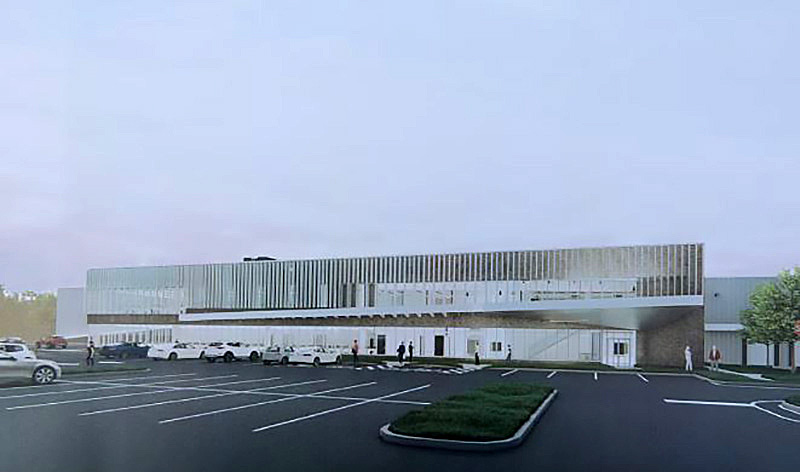
Another day, another data center.
At least that’s how it can seem lately, as proposals for the facilities continue to surface across New Jersey with increasing frequency.
This time, the focus is on a project taking shape along Route 1 in South Brunswick, where construction is underway even as opposition continues to grow and state regulators consider an air pollution permit tied to its operation.
The New Jersey Department of Environmental Protection has extended the public-comment period on the proposed permit until Monday, Nov. 9, giving residents more time to weigh in on the diesel-powered generators planned for the facility.
The extension follows requests from three state legislators and objections from Princeton officials, who have urged the state to deny the permit because of concerns about air pollution affecting neighboring communities.
State Sen. Andrew Zwicker and Assembly members Roy Freiman and Mitchelle Drulis requested additional time in an Oct. 2 letter to DEP Commissioner Ed Potosnak. The lawmakers, who represent the 16th Legislative District, said the original Oct. 7 deadline gave residents insufficient time to review the application and prepare comments following a Sept. 23 public hearing.
The legislators said approximately 200 people attended the hearing, with about 30 offering testimony.
The permit concerns the Sentinel Princeton Nurseries Data Center, a 341,000-square-foot facility under construction at 4405 Route 1 on the former Princeton Nurseries property, just north of the Mercer County line and close to Princeton and Plainsboro.
The state is considering an initial preconstruction permit and certificate to operate for the facility, identified as PN-DC1. The draft permit covers 12 diesel-fired emergency generators, each rated at 3,620 kilowatts, that would provide backup power when the primary electrical supply is unavailable.
The permit would limit routine testing and maintenance to 28 hours annually per generator, while allowing operation during qualifying emergencies. DEP’s review includes an assessment of potential health risks from emissions. The department has said its analysis found the risk to be negligible under its technical standards.
But opponents question whether those standards adequately account for the combined emissions from the generators and the proximity of homes, schools and other communities.
On Oct. 1, Princeton Mayor Mark Freda and the Princeton Council issued a statement calling on DEP to reject the application in its present form.
“We have grave concerns regarding how the backup diesel generators planned for the data center in neighboring South Brunswick will affect our community,” the officials said.
They said emissions could affect residential neighborhoods and two elementary schools in Princeton. The governing body also challenged the classification of the generators as minor sources of air pollution, arguing that their combined operation could produce more substantial effects.
Princeton officials referred to 20 generators in their statement, while the draft state air permit specifically covers 12 diesel-fired generators. The difference has become part of the broader questions surrounding the facility’s proposed backup power system.
The town also recommended consideration of renewable energy systems with battery storage or other alternatives to diesel generation.
DEP has not announced when it will make a final decision. The department has said it will consider testimony from the September hearing and written comments received during the extended period before issuing its determination and a formal response to comments.
Residents can submit comments through the department’s online form at dep.nj.gov/boss/permit-comment-form. Comments should identify the facility as PN-DC1, Program Interest Number 19525, and Permit Activity Number PCP250001.
Written comments may also be mailed to Nibras Mir, NJDEP, 401 E. State St., Second Floor, P.O. Box 420, Mail Code 401-02, Trenton, NJ 08625-0420. Comments must be received by Nov. 9.
The permit proceeding is separate from the local land-use approval that allowed the data center to be built. South Brunswick has already approved the project. The state proceeding deals with air pollution requirements associated with equipment that will be operated at the facility.
That distinction is important because opponents who were unable to stop the project through the local approval process are now focusing on other avenues, including state environmental review and the courts.
Area opponents have raised particular concerns about diesel-powered emergency generators and the amount of fuel that would be stored at the site. They have said the backup system would involve approximately 400,000 gallons of diesel fuel and have questioned the potential effects of generator testing and emergency operation on surrounding communities.
The project is being developed and operated by New York City-based Sentinel Data Centers, with WRV Nurseries South Brunswick Owner LLC listed as the applicant for the South Brunswick site.
Sentinel has developed and operated more than 3 million square feet of large-scale data centers in several regions of the country. The company says it has active developments in New Jersey, Pennsylvania, Northern Virginia, Washington state, Indiana and Ohio, including a roughly 100-acre campus outside Philadelphia.
The South Brunswick project calls for a 341,000-square-foot data center on approximately 143 acres within the Princeton Nurseries Redevelopment Area. Interstate Drywall Corp., which was awarded a drywall and carpentry package for the project, says construction is underway and completion is expected by the end of 2026.
But the start of construction has not ended the debate over the project.
Instead, opposition has increasingly spread beyond South Brunswick as residents, environmental advocates and neighboring communities raise questions about air pollution, energy and water use, the environmental history of the property and the broader implications of large data centers moving into the Route 1 corridor.
The location of the Sept. 23 DEP hearing at the Princeton Marriott at Forrestal in Plainsboro highlighted how the debate has expanded beyond the municipality where the facility is actually being built.
Although the data center carries the Princeton Nurseries name, the project is in South Brunswick. Still, Princeton, Plainsboro and Kingston are all close enough that residents there have increasingly taken an interest in what is rising along Route 1.
The land itself has a history that stretches back more than a century.
Princeton Nurseries was established by William Flemer Sr. in the early 20th century and became one of the most important commercial nurseries in the country. At its peak, the operation occupied well over 1,000 acres and employed hundreds of workers, producing trees and plants that were shipped throughout the country. The nursery developed varieties including the Princeton Elm and Snow Queen Hydrangea.
Its location was no accident. The fertile land around Kingston provided room to grow, while the nearby railroad and Delaware and Raritan Canal offered transportation connections to major markets.
The nursery eventually expanded across portions of South Brunswick, Plainsboro, Franklin and West Windsor. By the time the Kingston operation closed in 1995, it had shaped both the landscape and identity of the area for generations.
Parts of that landscape were later preserved.
In 2005, the state, South Brunswick and Princeton University were involved in an effort that protected significant portions of the former nursery property, including historic buildings, fields and land adjoining the Delaware and Raritan Canal State Park. The preserved core includes the Mapleton Preserve and historic nursery structures that remain visible today.
The surviving Princeton Nurseries Historic District was later listed on the National Register of Historic Places.
But hundreds of acres outside the preserved areas remained available for development, and debates over what should happen there have gone on for decades.
Princeton University had purchased large portions of the former nursery property, and plans for major development date back at least to the late 1980s. Some proposals were rejected, revised or abandoned as residents raised concerns about development around Kingston and the remaining nursery landscape.
South Brunswick’s zoning framework for the property also goes back more than two decades. In 2003, the township created an Office Corporate zone covering former Princeton Nurseries property. The zoning was intended to allow executive and corporate offices, high-technology research facilities, hotels, conference activities and certain public utility uses as part of comprehensively planned development.
That zoning itself became the subject of litigation.
South Brunswick residents Mark and Katherine Smith, who own property adjoining former Princeton Nurseries land, challenged the township’s zoning and later became involved in litigation over a PSE&G electrical substation proposed on a portion of the site. Their challenge to the 2003 zoning ultimately failed, with an appellate court finding, among other things, that the effort to overturn the ordinances had been filed years after they were adopted.
Those earlier disputes are separate from the current data center case, but they demonstrate that disagreements over development of the former nursery lands did not begin with artificial intelligence or the recent boom in data centers.
The latest redevelopment push accelerated in 2024.
South Brunswick adopted a new redevelopment plan covering approximately 160 acres along Route 1, Ridge Road and Mapleton Road. The land was divided into separate development districts intended to encourage economic development while addressing environmental features of the property.
WRV later acquired the remaining development property from Princeton University.
In March 2025, WRV Nurseries South Brunswick Owner LLC applied for preliminary site plan approval to construct the approximately 341,000-square-foot data center on a 142.877-acre parcel in the Office Corporate zone. Plans also included surface parking, landscaping, lighting, stormwater management and associated improvements.
South Brunswick approved the plans in May 2025.
By 2026, the project had moved from plans on paper to a construction site, but opposition continued to grow.
A South Brunswick resident launched a petition seeking to stop the project, arguing that the township should reconsider or suspend its approvals. The petition had attracted hundreds of signatures by early summer.
South Brunswick Mayor Charles Carley, responding to concerns about data centers, said the township has hosted smaller data facilities for years but acknowledged that newer facilities can be different because of their scale and energy demands.
Environmental concerns have also focused on the site’s agricultural past.
Historic nursery and farming operations left pesticide contamination on portions of the former Princeton Nurseries property. An earlier environmental investigation of a 74-acre parcel identified dieldrin as a primary soil contaminant associated with historic pesticide use. That finding dates from an earlier dispute involving nursery property and does not by itself establish the conditions on the specific portion now occupied by the data center, but it has contributed to broader concerns about disturbing former agricultural land.
Environmental advocates have also pointed to the site’s proximity to waterways, wetlands and preserved lands and have called for close scrutiny of construction and operations.
The project is also back in court.
Mark and Katherine Smith challenged the designation and planning process that cleared the way for the data center. The case went to trial Aug. 25, with the court ruling against their challenge Aug. 28. The Smiths subsequently filed an appeal, keeping the legal fight alive even as construction continues.
The appeal represents another route through which opponents hope to challenge a project that has already secured its primary municipal land-use approvals.
At the state level, the Sept. 23 DEP hearing provided another opportunity for residents to raise concerns.
The timing of the hearing was notable.
One day earlier, on Sept. 22, the Sherrill administration announced a $1.07 million penalty against a data center in Vineland after DEP inspectors found 62 large natural-gas generators installed and operating without required air permits.
The state called it the largest data center-related air pollution enforcement action in New Jersey history.
The Vineland case is unrelated to the South Brunswick project, which is going through the state air permitting process, but it illustrates why generator permits have become a significant part of New Jersey’s emerging regulation of large data centers.
The debate is also taking place as state policy toward the industry changes rapidly.
Gov. Mikie Sherrill signed legislation Aug. 27 requiring data center owners and operators to report their energy and water consumption to the New Jersey Board of Public Utilities twice each year.
Those reports must include total energy consumption, energy used by information technology equipment and cooling systems, peak daily water use, water sources and information about on-site and backup power supplies.
Sherrill signed the legislation in South Brunswick, where the Princeton Nurseries project had already made the community part of the statewide discussion over data centers.
The reporting requirement followed legislation signed in July creating a separate ratepayer class and rate structure for large data centers.
Under the law, the BPU is charged with developing standards intended to make data centers pay for their own electricity demands and associated grid infrastructure rather than shifting those costs to residential and other utility customers.
Lawmakers are also considering additional restrictions on the development of large data centers.
On Oct. 1, Zwicker and Sen. Joseph Cryan introduced legislation that would require DEP to study the environmental and infrastructure effects of data center development, including electricity and water consumption, air quality, noise and land use.
The measure, S4659, also proposes a temporary prohibition on construction of new data centers while the study is completed. Projects already approved or under construction when the legislation takes effect would be exempt.
Zwicker is also a co-sponsor of legislation, S680, that would establish energy planning and clean energy requirements for artificial intelligence data centers and cryptocurrency mining facilities. That bill advanced through the Senate Environment and Energy Committee in March and was referred to the Senate Budget and Appropriations Committee.
Those measures reflect how quickly the issue has moved from a local zoning matter to a statewide policy debate.
Demand for data centers has surged with the growth of cloud computing and artificial intelligence, both of which depend on enormous amounts of computing power housed in buildings filled with servers and related equipment.
Unlike a conventional office park, however, a large data center can have infrastructure demands that are difficult to judge simply by looking at its square footage.
Electricity use, backup generation, cooling, water consumption and noise have become major issues in communities considering the facilities. At the same time, developers and state officials point to construction spending, tax revenue and New Jersey’s potential role in the growing artificial intelligence economy.
That tension is playing out elsewhere in Middlesex County.
New Brunswick recently began a re-examination of its master plan that specifically includes data centers.
City officials said planners will examine existing zoning, infrastructure, utility capacity, environmental and public safety issues, compatibility with surrounding development and whether new standards should govern data centers. Other Middlesex County municipalities, including East Brunswick, Monroe, North Brunswick and Old Bridge, have moved to prohibit them, while Sayreville established a moratorium.
New Brunswick officials have taken a more measured approach, saying a planning record should be developed before the city decides whether a prohibition or detailed development standards are appropriate.
The city later said the master plan review would look at electricity and water demand, noise, environmental effects, emergency services, setbacks, buffering, building design and infrastructure capacity.
The South Brunswick project brings many of those same questions directly to the Route 1 corridor.
It also presents a striking contrast with what is planned immediately to the south.
The former Princeton Nurseries property extends across South Brunswick and Plainsboro. WRV purchased approximately 272 acres from Princeton University in 2024, but the two portions of the property are being redeveloped in dramatically different ways.
On the South Brunswick side is the data center.
On the Plainsboro side, the Planning Board approved a massive mixed-use development in June 2025 on approximately 109 acres.
That project calls for 950 residential units, including apartments, townhouses, single-family housing and senior housing, along with a 75,000-square-foot hotel and nearly 320,000 square feet of commercial space.
Together, the two projects illustrate the transformation underway on one of the largest remaining undeveloped stretches of the Route 1 corridor.
One side of the former nursery property is envisioned as a new residential and commercial community. The other will house a large computing facility with an entirely different relationship to roads, utilities, energy and neighboring communities.
The contrast also underscores why the South Brunswick project has attracted attention beyond its municipal borders.
Route 1 development has never stopped neatly at township lines. Housing in Plainsboro can affect West Windsor schools, businesses and traffic. Development in South Brunswick can affect roads and environmental resources used by residents of Princeton and Plainsboro.
Data centers add electricity, water, backup power and air emissions to that list of regional concerns.
The Sentinel project is already well beyond the conceptual stage. The local approvals have been granted, construction is underway and contractors expect the facility to be completed by the end of 2026.
But the debate over the former Princeton Nurseries site has lasted for decades, through preservation efforts, zoning changes, development proposals and previous court battles.
The data center is simply the latest and perhaps most technologically complex chapter.
And with an appeal pending, a DEP permit still under review and New Jersey rewriting the rules governing data centers statewide, construction has not brought an end to the debate over what the project will mean for the communities surrounding it.

