

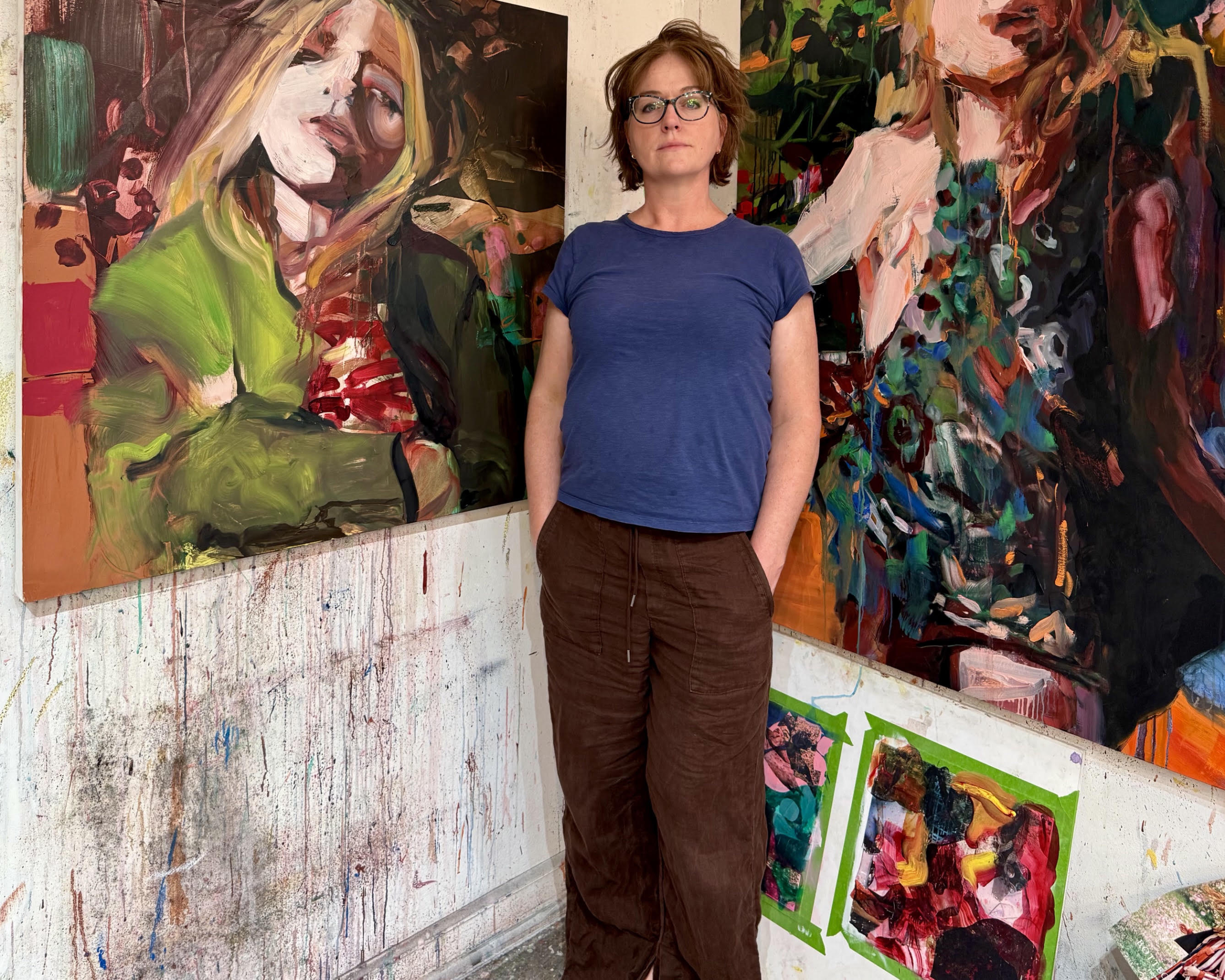
Theresa Pfarr is a painter of closely cropped female figures that create colorful, emotional and introspective portraits. She is a professor of drawing and painting at The College of New Jersey and has exhibited all over the United States. Her work in acrylic, oil and watercolor, with its striking intensity, has won many awards and accolades, most recently the Best in Show Award at the prestigious Ellarslie Open annual juried show at the Trenton City Museum.
When did your painting evolve from traditional figure representation to your current more abstract style?
My work evolves so slowly over time and moves forward and backward. I’ll stop painting with a certain color or stop dealing with space or composition in a certain way but then pick it up again. So, I cannot really point to a moment in time where there was a noticeable shift, but I’ve always loved generous work that offers more than realism with a more charged surface of color and texture. All of the best abstraction is informed by realism at base. The rules of light, space, line and color, etc. are at play in abstraction as they are in realism. I think when playing the line between abstraction and realism the meaning in a painting often happens where a painter chooses to let go.
Who were some of your early influences and inspirations?
Like many students, my very first influences were impressionist painters, including Van Gogh, Mary Cassatt, Degas, and Monet. Currently, Pierre Bonnard and Edouard Vuillard are my favorite impressionists. The dazzling textures and shifting color layers in their paintings fascinate me. So many layers go into Monet’s paintings, for example, the surface is suffocated with pieces of paint piled one over the other. It’s a kind of chaos that doesn’t make sense on close inspection but is so well-orchestrated that when you stand back it just sings. When I construct my paintings, I look for the same kind of wrong ways to build imagery with a push and pull of materials. I am looking for the right wrong way to paint. I make a lot of bad paintings in this process and will often turn a work upside down mid-development and continue the painting in a new direction. I wouldn’t call it “painting over” because much of the first layer of paint is preserved in the final state. It’s a way of pulling the image out of chaos.
What fight/struggle do you have regarding your art? (Studio space, money for supplies, physical limitations, time to create, recognition, sales, etc.?)
Struggle is the right word, felt right now by many people in the current political and environmental climate, artist or not. That classic space, time and money struggle for artists! It’s a guilty privilege! I think I am just used to it as a permanent, luxurious condition of the artist’s life. A new struggle of late, personally, is the mental struggle of balancing showing work with the deep, quieter work of being in the studio. Painting alone and then putting the work out there is always strange. The paintings look drastically different to me after the public sees them and that doesn’t always stem from public feedback. I’m not sure why there is a shift. Maybe it’s just a feeling that the ideas in the paintings are no longer only mine or that I can now see the work through that lens of public perception.
You have undertaken a few artists’ residencies. Does your work change during these times away or does it become more focused?
I think whether a residency changes your work or deepens it is individual to the artist and the work they need to do, but artist residencies are really the answer to the space and time problem many artists face. The residencies I’ve been fortunate to attend were incredibly formative in how they opened up space and time, giving me room to ask hard questions in my work, explore technique and develop more meaningful work. A real shift occurred for me at the Roswell Artist-in-Residence program, a yearlong residency grant in New Mexico. The community, the immense, colorful landscape and the facilities there are so nurturing. That experience was truly life-changing.
The figures in your paintings are often female. Why do you focus on painting women? What are you communicating with your art?
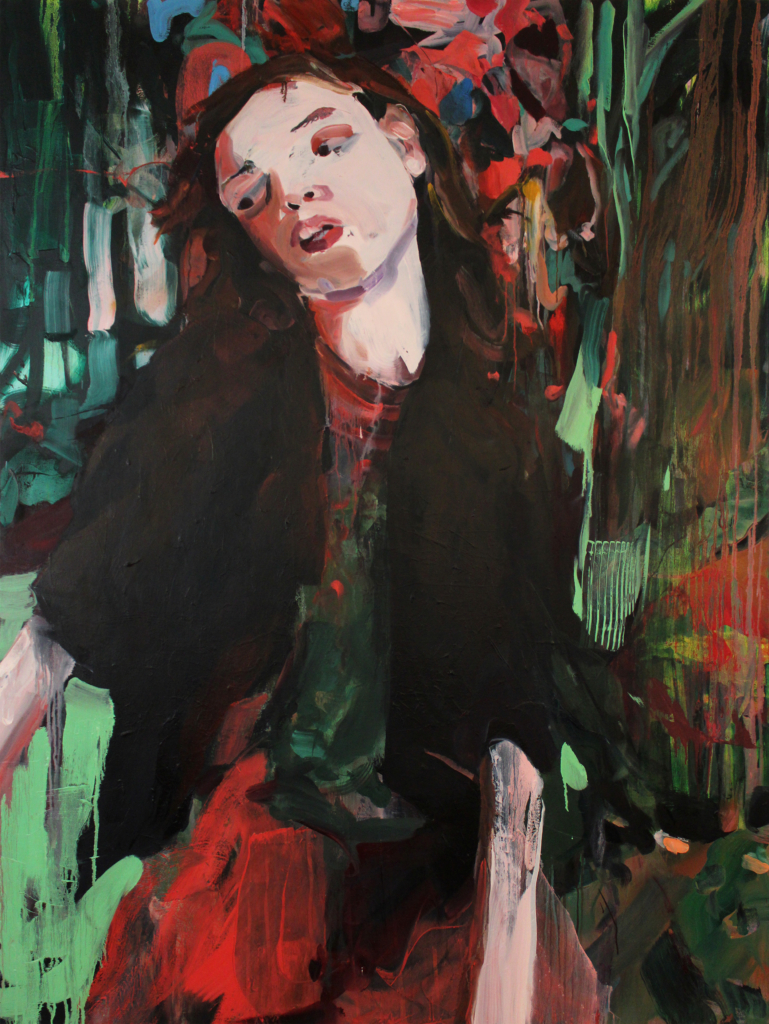
I suppose my work is partially autobiographical. I basically paint women because I am a woman and want to work from that personal vantage point. Ultimately, the message in my work is one of struggle between the figure, space and a sense of place. The figures in my paintings often appear to be female, while some figures have looked more androgynous. The focus for me is not so much on gender, but instead more on how the figures negotiate a congested, psychological and somewhat threatening space.
How is the dichotomy of teaching in some styles and painting in another? Do they balance each other?
I really enjoy students finding their own voice and working in a style unique to them. I really work to avoid championing particular styles in the classroom. However, the work I love to see in museums and in the classroom is work that shows a conversation between the artist and their materials. I do encourage my students to find that dialogue between their ideas and their materials. I don’t think that approach to making art is limited to one painting style.
Do you use preparatory drawings for your paintings?
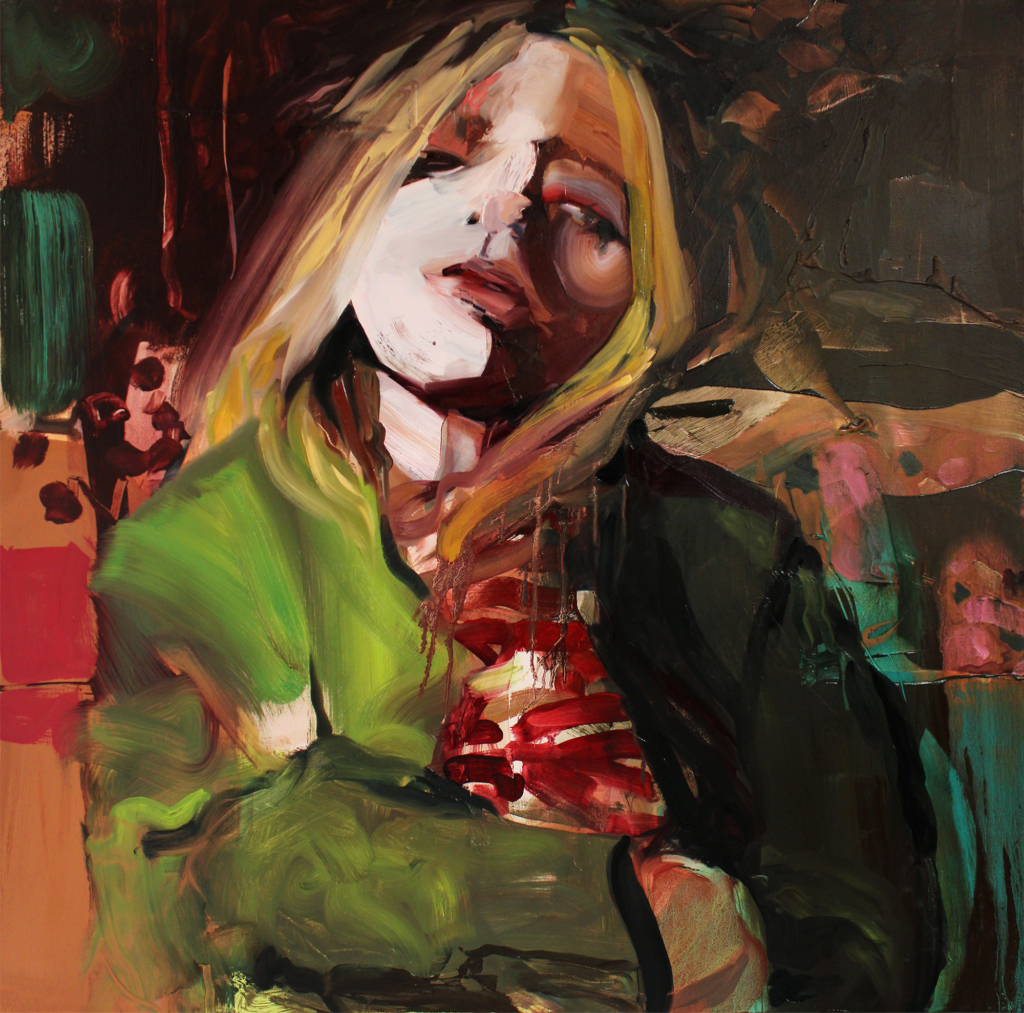
Sometimes I do, yes, but I use the sketches as a way of warming up, as a way to get into a zone of negotiating color and form. I begin a painting by planning for color and composition to an extent, but I allow the work to lead me very far away from my initial plan. I do have an initial broad point of inquiry in my practice conceptually regarding the figure vs. the environment. “Are we the products of our space or do we produce our space?” Our environment is everything to our perception of self. It is also nothing at the same time. Furthermore, what is figure painting vs. landscape painting? What is landscape if not a projection coming from the artist, the figurative subject within the painting or even the viewer’s projection? I believe making a landscape is a way to claim space, but making art altogether, for that matter, might be a way to claim space. In my work the space is a space of the protagonist’s own making. It’s an enclosed, flawed and personal space. Which is why space is often distorted, abstract and fragmented. Although the narrative in my work isn’t a clear one. I work to build a nonlinear story through layers of paint and levels of abstraction. I often will paint the figure into the landscape or vice versa, the landscape into the figure. Elements of landscape painting exist within the figure when a green expanse cuts into the figure’s hips like in this example, while the tree behind the figure looks fleshy.
I see you use almost pure black in your paintings. Is this planned or do you feel it makes the final contrast work better?
Black is a color to me and, for that matter, so is white. There is no neutral color in my opinion. Nearly neutral black and white in paintings take on color in the gallery, from lighting, from other colors in the room, etc. In some of my earlier work I worked with canvases primed with black gesso and built the figures on top, essentially building back light and intense color with the hope of achieving a more dramatic effect with light and color. Instead, I learned that the process required so many layers of paint and was exhausting. I’ve since moved back to painting on top of an imprimatura ground layer that’s more mid-value and muted color.
What is most fun about being an artist now compared to early on?
I think I am at a point where I know what I need to make and feel more certain about what matters to me in my work. I still do a healthy amount of searching and questioning that’s motivating, but early on at times too much uncertainty was paralyzing in making work. I think I would tell my younger self this: “Just do the work and realize it’s only a painting, it’s only art and you don’t need to be certain to make the work. Painting doesn’t define you, but it will change you. Through the work you find the most honest idea.”
What is on the horizon? What are you looking forward to?
Honestly, I am just looking forward to the possibility of carving out some time that feels endless and being focused in the studio.
Instagram: theresapfarr.art
Website: www.theresafpfarr.com

