

Ross Amico
When the Capital Philharmonic of New Jersey presents the opening concert of its 2026-27 season, it will do so with a new music director on the podium.
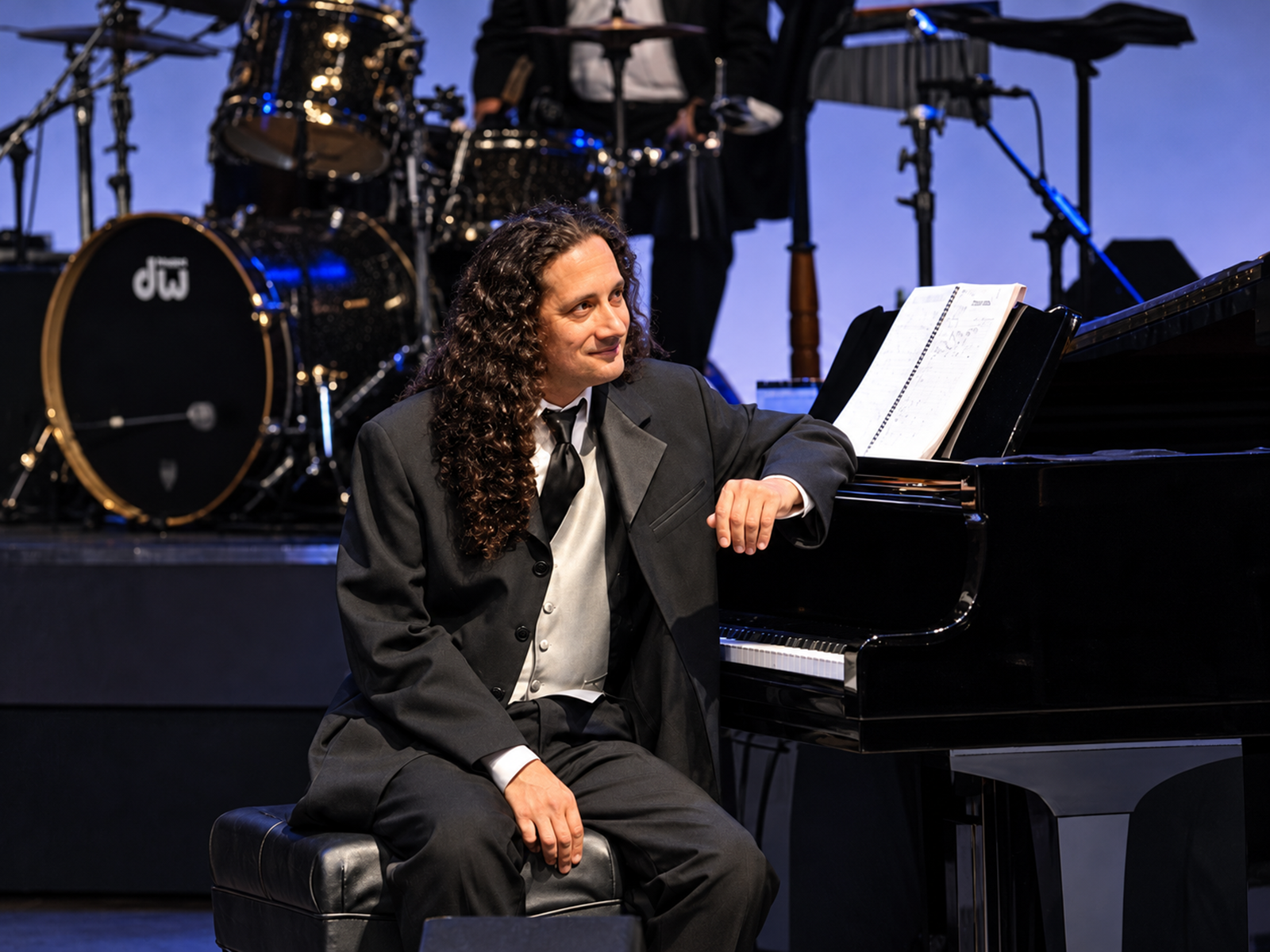
It will also include two world premieres of music by Princeton composer Vince di Mura that will synthesize diverse influences, including two Chinese choirs, a Cuban music ensemble and a symphony orchestra, for what promises to be an unusually festive evening.
The concert will take place at Trenton’s Patriots Theater at the War Memorial on Saturday, Oct. 24, at 7:30 p.m. But plan to get there early. Di Mura will set the mood with a preconcert talk and performance that will feature World War II-era French fashions modeled by the Silk & Rhythm Collective. Doors open at 6:15 p.m.
The unusual approach will launch this season’s overarching theme of “Turning Points.”
Di Mura, who is the Capital Philharmonic’s composer-in-residence, made a big impression last season with “Oh God … Beautiful Machine,” another genre-defying musical odyssey, set to texts by Pulitzer Prize-winning poet Yusef Komunyakaa, that channeled jazz, blues, gospel, samba, classical and folk traditions from around the world.
He serves as resident musical director and composer at Princeton University’s Lewis Center for the Arts. But that’s just his day job. The man is a musical refinery, absorbing, processing and exuding music of many genres, drawing from a massive creative reservoir to produce ambitious original works, recently on a breathtaking scale.
“L’Hôtel Ritz de Paris” is his latest pièce de résistance, in this case, quite literally, as it deals in part with the French Resistance.
Di Mura took as his principal inspiration Tilar J. Mazzeo’s bestselling book “The Hotel on Place Vendôme,” a history of the opulent Hôtel Ritz, recommended to him by his son. The luxurious Paris landmark was a magnet for celebrities and, during World War II, a hotbed for political intrigue.
Hermann Göring set up headquarters there. An armed Ernest Hemingway liberated its bar. Among its guests were fashion icon Coco Chanel and actress Arletty (perhaps best known to international audiences for Marcel Carné’s classic film “Children of Paradise,” made during the occupation). The establishment was managed by Claude and Blanche Auzello, both of whom relayed information to the Resistance.
The wealth of material set Di Mura’s head buzzing. After that, he read anything he could related to the subject: “The Rape of Europa,” about the Nazi plunder of European art; “Americans in Paris,” about the expatriates who remained through the war; “When Paris Went Dark,” about life under the German occupation; and “And the Show Went On,” about the cultural institutions that stayed open and the artists who continued to perform.
“I just read and read and read,” Di Mura says. “I just became obsessed with it.”
He approached Nuyorican playwright Migdalia Cruz, with whom he had worked at Princeton, to see what they could come up with. The original concept was a play with music. Cruz provided lyrics. Di Mura wrote songs. But their visions began to diverge. Both became busy with other things, and the project went into limbo. However, the collaboration yielded a lot of material for Di Mura to think through.
He added more songs. He put together a work for violin and piano. The piece would continue to evolve for six or seven years. At last, he arrived at the 12-movement structure for full orchestra, and then some, to be performed by the Capital Philharmonic.
“I have this terrible disease,” he says. “I call it the Mahler disease. Everything has to be 70 minutes long. And if it’s not, somehow I’m lazy.”
Fear not, the work will be presented with an intermission.
“It looks at the events of the Second World War through the eyes, or through the perspective, of celebrity,” Di Mura says. He views the work as a collection of musical portraits of people who inhabited the Ritz and events that were in some way connected to it. “In a weird way, I think I was writing a film score.”
But he also grapples with larger issues of defiance, political opportunism, antisemitism and a certain ambivalence associated with the liberation, a time for rejoicing but also one of shaming and retribution.
From his collaboration with Cruz, he kept the idea of the historical figure of Virginia Oldoini, Countess of Castiglione. Castiglione achieved notoriety as the mistress of Napoleon III. Known for her beauty and flamboyant dress, she had many lovers. She was also a significant figure in the early years of photography, collaborating with Pierre-Louis Pierson to create hundreds of posed photographs over a period of four decades. Many of these were recreations of autobiographical events.
In her declining years, she kept an apartment on Place Vendôme. The rooms were kept dark. She had no mirrors. She never went out, except at night. She died at 62 in 1899, about six months after the Ritz opened.
“She was very eccentric,” Di Mura observes. “Migdalia had the idea, the conceit, that she haunted the Ritz, and that she was a witness of the events.”
In a further nod to his colleague, Di Mura includes a Cuban music ensemble, partly as a tribute to Cruz’s Latin heritage, but also to suggest the presence of Ernest Hemingway, who owned property in Havana and kept a home in Key West. Di Mura sees the spirit of Hemingway as looming large over the work’s second half. So the piece is scored for full orchestra, solo violin and a five-piece Cuban ensemble. The violinist at Saturday’s concert will be Yang Jing.
The program will also include a shorter work, “Harmony Villa,” that started out as something Di Mura wrote for window manufacturer Thomas Chen, who requested music to celebrate Crystal Park, a private nature retreat and art park established for the enjoyment of his employees and business associates in Dutchess County, New York. Di Mura reconfigured the piece for two Chinese choruses. For the upcoming performance, the Edison Chinese Chorus and the Chinese American Music Ensemble will be joined by the Capital Singers of Trenton.
Di Mura points out that, for the past few years, he’s worked almost exclusively with the Chinese American community. He was especially eager to reunite with mezzo-soprano Lina Zha and pipa soloist Yang Jin (not to be confused with the violinist above). “They’ve been very good to me,” he says, “and I desperately wanted to have them involved in the show.” (Again, see Van Dongen’s article for more about it.)
Di Mura’s musical journey has been a fascinating one. Of Sicilian stock, he grew up in Central Jersey in a house he describes as unmusical. His father owned a body shop. His mother was a hairdresser.
He singles out his Uncle Benny as an exception. Benny played gigs in high-end venues in the 1950s, ’60s and early ’70s and would make more money on weekends than everyone else made during the week. He was the one who introduced him to Latin music, which he really loved and, according to Di Mura, played very well.
Di Mura’s older brother was enthusiastic about the blues. It was through him that he learned how to improvise. He developed “an absolute obsession with blues and, of course, by extension, jazz.” He found he adored George Gershwin. Then he discovered Irving Berlin.
“I was probably the only kid in 1972 listening to Benny Goodman, listening to Carmen Cavallaro, listening to Cab Calloway, listening to guys like Jimmy Lunceford,” he says.
His love of songwriting also caused him to fall in love with country music. “I loved Hank Williams. Loved Willie Nelson. I was playing Chopin, playing Schumann, but man, at night, I’d be listening to Hank. And I loved cats like Waylon Jennings.
“And of course I was listening to the blues.”
He credits blues as his entryway to composition. “Because blues was improvisation, and of course, the ticket into composition is in fact improvisation.”
Di Mura was already playing blues clubs at 8 and 9 years old. But then he started listening to classical music, and he fell for it hard. He begged his mother to buy so many records, he says, she told him she was going to go broke.
When he outgrew the neighborhood piano teacher, she referred him to the French School of Music in Plainfield, where he went on to study with Yvonne Combe. “When I heard the students at the French School, I was like, okay, I’m starting from zero. I went from being a professional musician to playing five-note scales.” But he progressed very quickly and began winning competitions. He played at Carnegie Recital Hall three times and studied abroad in Perpignan, France, with Jean-Paul Sevilla when he was 16.
Then he was accepted into the Manhattan School of Music, where he studied with Constance Keene. Again, he found himself thrown in the deep end, and he had to unlearn everything and rebuild his technique from scratch. But rebuild he did.
“He also exhibited a gift for theory. He blew through the two-year theory course and wound up having to fill out his schedule with graduate courses. Then he took composition. At the same time, his playing blossomed. When he was down with the flu but still had the confidence to go out and play a recital, he realized how well he had been prepared.
Then, when he was out in the real world for a couple of years as a professional musician, he began to recognize that he had some serious limitations. So he returned to study with Harvey Wedeen (who also taught super-virtuoso Marc-André Hamelin), and again he had to start all over. Wedeen rebuilt him into an even better pianist, to the point that he actually felt nervous while playing because it came so easily.
But then, as he neared the completion of his graduate studies, Wedeen asked him something that changed his life. “He said, ‘What do you have to say?’ And I realized at that moment I had nothing to say. That’s when I became a jazz pianist and a composer. Because I had nothing to say as a pianist.”
Di Mura soon won a grant from the New Jersey State Council on the Arts, and he was on his way.
“You know, I’ve had an amazing career. It’s been in the theater. It’s been in dance. I’m a professor at Princeton. But I had to find that thing I was playing when I was 8-years-old. I went back in my late 20s to what I was when I was 8. Except now I have a whole lot of ammunition.
“And I’ve spent the last 35 years, writing theater, writing dance scores, playing jazz, doing arrangements, doing all this stuff, and then, all of a sudden, what am I doing now? I’m back where I was when I was 28. I’m doing symphonic music. And I love it.”
“Turning Points,” Capital Philharmonic of New Jersey’s season-opening concert, Saturday, Oct. 24, at 7:30 p.m. at Trenton’s War Memorial, featuring two world premieres by Vince di Mura. Preconcert program begins at 6:15 p.m. capitalphilharmonic.org.

