

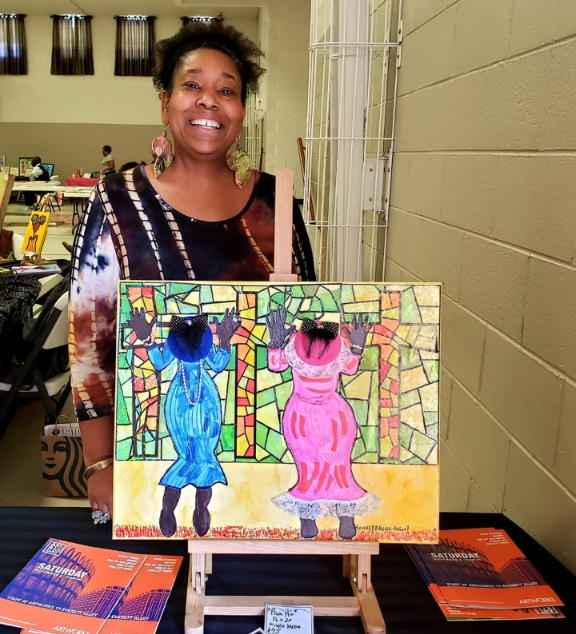
Beverly Keese-Kelley is a collage artist. She is a collage herself, immersed in history, culture, language, people and color. She is interested in everything. As a true artist does, she can make art out of any material, new or old and upcycled. Her enthusiasm spills over when she speaks of her family, upbringing and teaching the next generation the stories and history of the past. Her southern heritage, learned firsthand through family trips when she was young, inspires her to share her artistic lineage with people who may not know the struggles of the past. The Ewing artist’s work is like her: energetic, multifaceted, friendly and approachable.
What first got you involved in the arts?
I first got involved in the arts from being born to a mother who was an artist. Although, in her time, she never used that term to refer to herself. Once I grew up and realized through outside knowledge and experiences that her ability to design clothing, sew an outfit from scratch, decorate our home and create something we needed from recycled materials was absolutely the work of an artist.
Everything she did fascinated me, and I wanted to learn to do those things. I also began as a fashion designer and seamstress. With a growing family, I no longer had the ability to dedicate the time and concentration it required. I began using those same materials to help express other interests, like visual art. I also began creating assemblages focusing on my interest in historical and cultural storytelling.
Which media do you work in, and how do you decide which to use?
My medium of choice is mixed media collage. I use fabric, textiles, found objects, paper and other ephemera to assemble a visual story onto canvas and other surfaces, such as wood and cardboard. I also use silhouettes. I use these silhouette images when I need to add a human character to my storytelling. I also use my own photography in my collage work.
Who were some of your early inspirations?
As I said, my mom was my big influence. Her enthusiasm for art absolutely spurred mine. I grew up with several older siblings. The artwork and graphics on their record album covers had always fascinated me. I grew up watching PBS. There, I was introduced to folk artists like Joyce Scott, Betye Saar and Romare Bearden, just to name a few.
My parents were from Anderson, South Carolina. That was the heart of Gullah Geechee culture, descendants of slaves who worked on rice plantations. The Gullah Geechee had their own culture, language and customs. My mother would relay to us the traumatic stories that were passed down by oral history. That spurred my interest in the history of African Americans in the U.S. My father was the upbeat one who would tell us stories to make us laugh and be happy. They came north, as so many did during the Great Migration, to escape harsh Jim Crow segregation and agricultural crises that caused continuing poverty. Many settled in New York, New Jersey and Philadelphia.
What are you communicating with your art?
As an African American, it is important to me to communicate and express my identity through my art. I attempt to tell the stories of where our roots might be from, the day-to-day life of our ancestry and recreate their creative processes using the mediums they used. I also create images that express faith and joy.
Please share what you feel is the best part about teaching.
The best part about teaching is sharing with young and old students that they, too, can take raw materials from the idea stage to a tangible item, and then there is that celebration moment of “look what I made!”
Are young or adult students more receptive to learning how to make art?
I began teaching how to make art through my church. As I enjoyed art and volunteering, it was a natural fit. I don’t think either one is more receptive. I feel it is more of an individual thing. From my years of observation, receptive learning begins once the willingness to explore trial and error begins, and that is regardless of age. I have taught classes for the city of Trenton after-school program, various summer camps, youth groups, adult day care and child and adult crafting groups.
How did you get involved and on the board of trustees at the Trenton City Museum at Ellarslie?
I’ve always enjoyed volunteering and giving back whenever time permitted for church, my children’s youth groups and the PTA. After retirement, I was able to engage in more art-focused volunteerism, like joining local art boards and associations. As I was at the Trenton City Museum quite a bit, the next thing was I was asked to be on the board of trustees.
What fight or struggle do you have regarding your art?
I don’t think I’ve ever struggled in regard to my art. I’ve always seemed to figure it out. I’ve always been an optimistic-thinking person. Challenges arise in any line of work; it helps when you are looking forward to finding a solution out of passion.
Please share about the vision and mission of the Ewing Arts Commission.
The Ewing Arts Commission was founded in 2009. It dedicates itself to serving not only visual artists, but also performance, literary and musical artists in Ewing. A small but mighty group of volunteers enthusiastically give of their time, organizing and curating art shows in the Ewing Municipal Building. The commission has currently done a great job with the America 250 display. Stop in any day of the week during office hours; it is on view through December. Check the website. Every first Tuesday is Talk Ewing Arts. At the Ewing Municipal Building every first Thursday, please come out to support the monthly featured artist.
What is most difficult about being an artist?
The most difficult thing about being an artist is not having enough hours in the day to create everything that comes to mind. My brain is always creating. Sometimes I cannot sleep because I have an idea that needs exploring. I rarely write down the details but have it all up here. Making collages, I am always on the hunt for materials. I use upcycled materials and sometimes wait a couple of years until I find that last piece of the puzzle to make the collage complete. That takes a lot of patience, but that is my process.
What is the most rewarding part?
The most rewarding thing about being an artist is finishing a piece and being able to finally complete something I’ve been working on and waiting to come to fruition.
What is on the horizon? What are you looking forward to?
I’m also a crafter and artisan. I’m always coming up with a new way to use recycled materials to create art. I’m excited to have ideas completed for two future solo exhibitions, one using textiles and the other an Afrofuturism exhibit created mainly with my photography.
Once I have the exhibitions complete to my liking, I will seek out venues to share them with the public.
instagram.com/keesekelley.artmaker

