

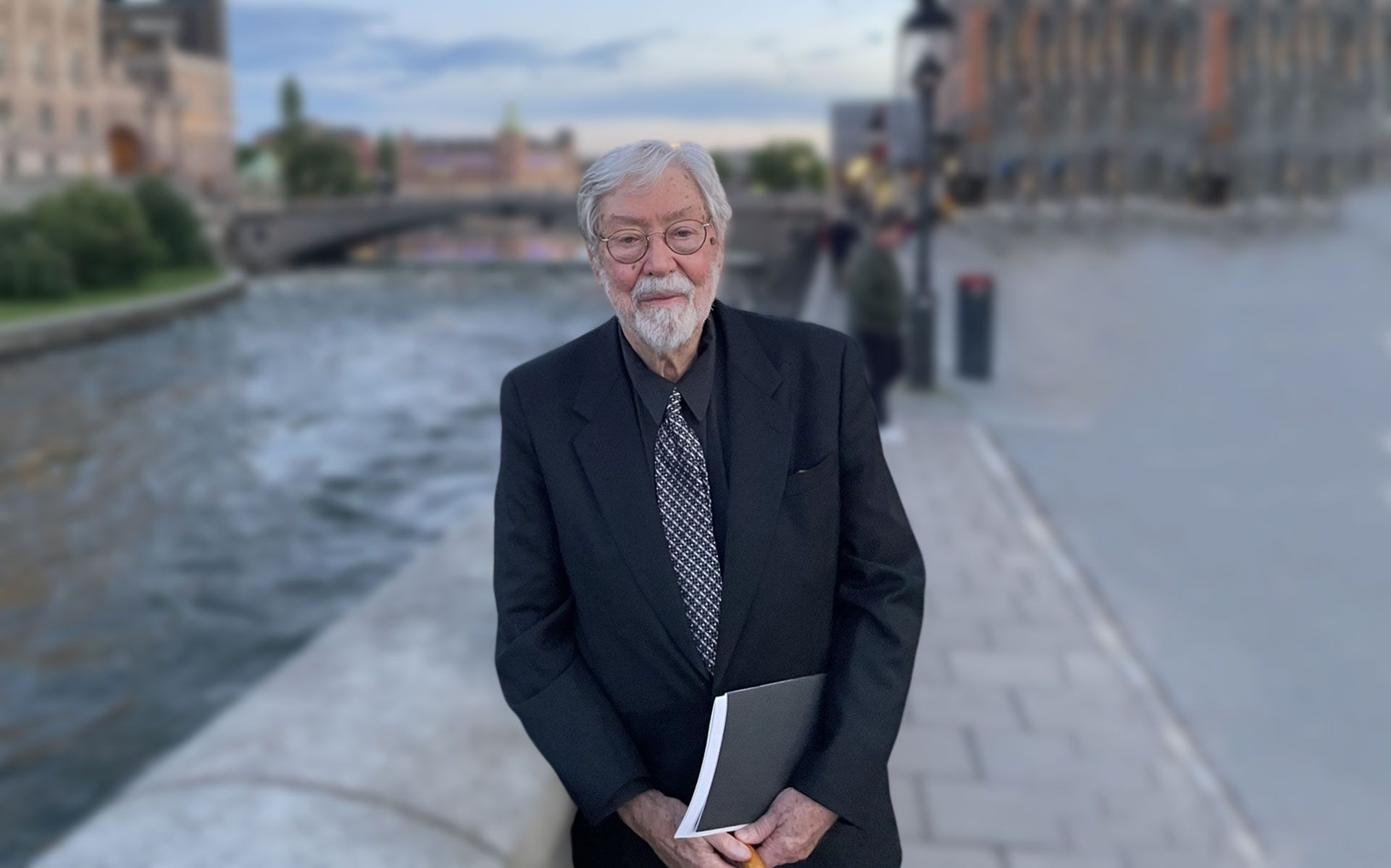
One approaches through the side door of a historic home on Main Street with a certain restraint, as one might at the entryway of a sacred place.
Inside the 1840 house lives Andrew Rudin, an 87-year-old composer and pioneer of electronic music whose career has stretched from experiments with Robert Moog’s early synthesizer to music used by legendary Italian filmmaker Federico Fellini.
The well-kept home sits quietly in Allentown’s Historic Village, not far from Conine’s Millpond and the Old Mill. It’s a casual stroll to Heritage Park or up South Main Street to the high school.
Rudin has lived in Allentown since 1992, after a career at the forefront of electronic and avant-garde music. He worked with synthesizer pioneer Robert Moog, saw his music used by Fellini and taught generations of young composers at institutions including the University of Pennsylvania and the Juilliard School.
Now, from his Main Street home, Rudin is looking back on that career and confronting a question that has become increasingly important to him: What happens to his music after he is gone?
Rudin understands that, despite earning international recognition at a young age, he is not what the average music enthusiast might consider a household name.
“I do not write my compositions with a particular audience in mind,” he said. “I write music that I would want to hear.”
Rudin (pronounced Ru-deen) hails from the small town of New Gulf, Texas, not unlike Allentown, he insists, and began his unlikely journey as so many revolutionary and misunderstood talented kids do: trapped in worlds that are too small to hold the mind-bending beauty that they are destined to share with an arguably intellectually lazy world.
“I was lucky in some ways,” he said with some slight hesitation. “I was a gifted kid who became aware of the gift, a little unsure of what to do with it, perhaps, or where it might take me. But with enough sense to realize that the talent is a gift that must be worked at. And so I did. I kept working at it, kept developing it, and eventually, once I found the right place, the right composers to study with, I was able to take advantage of it. The result was that it brought me international recognition at a young age.”
The young Rudin originally traveled to the East Coast to the University of Pennsylvania’s Graduate Department of Music in Philadelphia from the University of Texas before he had formally finished his undergraduate degree. His parents eventually made him go back to finish the B.A., but it was at Penn where he truly began to flourish and make important strides in his musical and academic career.
Ironically, perhaps, the ultimate modernist composer-in-the-making, whose influences included leading modernist musical lights such as American composers George Rochberg, Ralph Shapey and Kent Kennan, German luminary Karlheinz Stockhausen and Austrian Paul Amadeus Pisk, was initially unsure where to go to hone his unusual talent, art and craft.
Rudin found that the music he yearned to compose was not yet welcomed at home in Texas. A professor there suggested he reach out to Penn, and so began the trek eastward and the journey into modern 12-tone electronic composition.
The composer has lived in the Historic Village of Allentown since 1992, when he moved in with his life partner, the late Tom Quenan.
“I fell in love with the person who lived in this house,” Rudin said. “We spent 20 years here together and when he passed, I found that he had left it to me.”
Rudin said that he enjoys living in Allentown and its small-town rhythms.
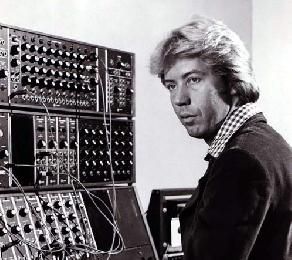
Rudin is well known for working with Robert Moog, the creator of the Moog synthesizer, on the composition “Il Giuoco” while still studying for a graduate degree at the University of Pennsylvania.
“Il Giuoco,” the celebrated Rudin composition that represented the United States in the 5th Paris Biennale, was the first large-scale project for Moog, who would go on to work with the Beatles (“Here Comes the Sun”) and early fusion jazz-rockers Emerson, Lake & Palmer, among many other major names in the experimental rock scene.
The musicians in the fusion rock scene generally used the Minimoog synthesizer.
The composer remembers Robert Moog and their dynamic time together in 1966 well, saying, “Bob and I embarked on a rather challenging endeavor. He was kind of unassuming and seemed surprised that people wanted to use his invention to make new forms of music and even more so that I wanted this large, room-sized synthesizer to create my compositions at the University of Pennsylvania.”
After working and studying tirelessly for some 10 years in the field of creating electronic music, Rudin wanted more.
“I wanted to do something new,” he said.
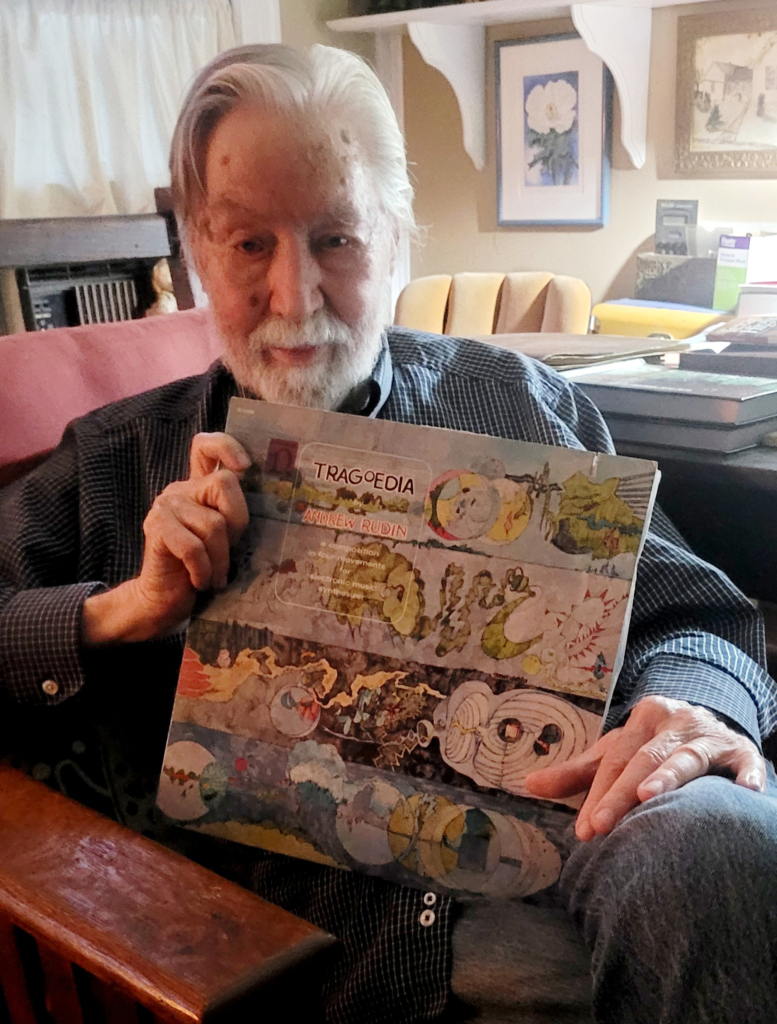
“This,” he said, holding a copy of “Tragoedia,” his first LP album recorded in 1968 by Nonesuch Records, “is what changed my life.”
“Tragoedia” consists of four movements for an electronic synthesizer.
“The idea that I was 26 and I had no real reputation at that point. And yet they [Nonesuch] gave me an entire LP, no questions asked and paid me a handsome fee to make a piece while trusting that they would get something worthwhile for it.”
He spent years teaching younger music hopefuls at the University of Pennsylvania and the Juilliard School in New York, among other influential music colleges.
It was then that the album was released, and a student of Rudin’s mentioned that “Tragoedia” had received a positive review in High Fidelity Magazine by respected music critic Albert Frankenstein of the San Francisco Chronicle.
Frankenstein wrote, “This is the single best electronic piece I have ever heard. With Andrew Rudin electronic music finally comes of age.”
Rudin, too, at 26, had come of age, although the composer still insists his first composition working with the synthesizer is better than “Tragoedia.”
“I’m at a point in my life where I’m wondering, ‘What did I write all these works for?’” Rudin muses at 87. “They don’t seem to have any life of their own. So, I’m wondering once I’m gone in the next couple of years, what will become of this stuff? You know? Will it have any ongoing life?”
The composer leaned forward to make the point.
“Who wrote the opera Carmen? It was a young Frenchman, Georges Bizet, who died in his thirties thinking that it was a failure because it flopped at the box office, the critics of the time hated it. Of course, we know that Carmen ranked as one of the top three operas ever written. There’s a saying: the ABCs of opera: Aida, La Bohème, Carmen. Verdi is Aida, Puccini is La Bohème, and Bizet is Carmen. And this man died thinking he was not a success.”
He fixes me with a keen look, eyebrows arched.
“Look, you don’t know what will happen.”
Rudin’s interest in theatrical music, his website recounts, “resulted in ballets for the Pennsylvania Ballet, Murray Louis Dance Theatre Workshop, Louis Falco, Jeff Duncan, London Contemporary Dance Theatre, and four collaborations with Alwin Nikolas, as well as incidental music for Tennessee Williams’ Outcry and numerous scores for PBS Television.
In 1972, his opera, The Innocent, was produced in Philadelphia by Tito Capobianco. [Rudin’s] orchestral and chamber music has been performed throughout the United States by such artists such as pianists Lydia Artymiw, Beth Levin, Steve Beck and Marcantonio Barone, violinists Diane Monroe and Miranda Cuckson,” among many other classical and modernist musicians of every stripe: percussionists, violists, flutists, clarinetists and more, who have “brought him renewed recognition.”
Notably, Rudin is the recipient of an Artistic Fellowship from Yaddo, the artists colony in Saratoga Springs, New York, as well as fellowships from the “MacDowell Colony, Ucross Foundation, the Virginia Center for the Creative Arts, and the Pennsylvania Council on the Arts,” among numerous others.
Much attention, even the quietly modest maestro admits, has been given to the use of his work in the famous, or infamous, absurdist 1969 film Fellini Satyricon by legendary Italian director Federico Fellini.
If the reader is not familiar with the film, think of something akin to a surrealist fever dream: hallucinatory, disconnected episodes that take the viewer into lands of vivid nightmare and garish and grotesque imagery that blend the distant ancient past and the postmodern present.
Rudin discovered via a long-distance phone call from a film studio in Italy that Fellini wanted to use some of his work in the new, experimental film he was making.
Rudin said that, at the time, he only really revered two major directors, Stanley Kubrick because of his 1968 science fiction masterpiece “2001: A Space Odyssey,” and Fellini because of his film “La Dolce Vita” (1960), but more especially “8 ½” (1963).
“I was thrilled,” Rudin said. “That summer I even went to Italy and to Rome. I eventually got to meet with someone from his production company. But it was unclear what was going to happen. I never signed anything giving permission for them to use my work. Time went by and I didn’t hear anything. So I figured, ‘Oh well, I guess it fell through.’ But then a friend told me they had seen a screening of Fellini Satyricon and apparently I had a film credit. ‘Wonderful!’ But then I thought, ‘Wait a minute, where’s my paycheck?’”
Rudin never did get his commission for the use of his music by Fellini.
“I tell people that I occupy a niche in the world of music,” Rudin says in reflection. “Not only a niche, but I think, a niche within a niche, within a niche, within a niche. In other words, I have become increasingly out of the mainstream, the further I went and the more my reputation grew, but it also means that there are very few people who are interested in what I do.
“There is a small, devoted public that are interested in what modern composers are doing, but most people in America don’t care about classical music in general, much less the more esoteric types of classical music created by living modern composers who are looking to extend the tradition. Consider that most people have never heard of [Igor] Stravinsky’s ‘The Rite of Spring.’”
I protest that it is almost unthinkable, but Rudin holds forth to make his point.
“Stravinsky wrote ‘The Rite of Spring’ in 1913 — well, to me, that’s ancient history, but many people consider it a modern composition. If you went out on the street right now and asked people to hum the opening notes of ‘The Rite of Spring,’ most people would look at you like you were crazy,” Rudin said.
“It was created after what people think of as being after the composition of classical music,” he said. “If I tell people that I am involved with classical music, they think, ‘Oh, Beethoven and Mozart!’ No, no, we left that behind hundreds of years ago. Of course they’re wonderful, of course we’re all influenced by those great figures. But if I look back at the composers who were influential to me, I think of the 20th century, and it would have been the French composer [Olivier] Messiaen (1908-1992) and the Polish composer [Witold] Lutoslawski.”
Rudin confessed, however, that when he taught at the Juilliard School in New York City, the great Polish composer arrived as a guest instructor and he was not familiar with any of his work.
“But now I hold him in the same esteem as Stravinsky. Now I feel like an idiot — as if I sat next to Beethoven and said, ‘Oh, you write music?’” he laughed.
Rudin said he became entranced with Lutoslawski’s work after hearing a particular, exquisite chord whose composition, origin and placement he still cannot quite identify.
“Once I heard a particularly popular work of his, and I was about halfway through the first movement and everything stopped for a moment where there was one beautiful chord in the orchestra,” he said. “Every time I hear that chord, I think, ‘My God, what makes that so beautiful?’ Is it the pitches? Is it a particular instrument? Is it the way it’s played? I couldn’t understand why it struck me so profoundly, so I went out and bought the score because I wanted to see what was going on there.
“I still can’t fully answer the question. But it came to the point that I could not find a work by him [Lutoslawski] that I didn’t think was terrific. I mean Bach wrote 250 church cantatas and you can reach into any of them at random and not find a dud. How does someone possess that level of talent? So, I feel so incredibly humbled even being in the same field of calling myself a composer next to someone of that accomplishment. It’s just phenomenal. But that’s not really the point. The point is that I write the music that I want to hear. If it pleases me, I have to be satisfied with it and anything else is gravy.”

