

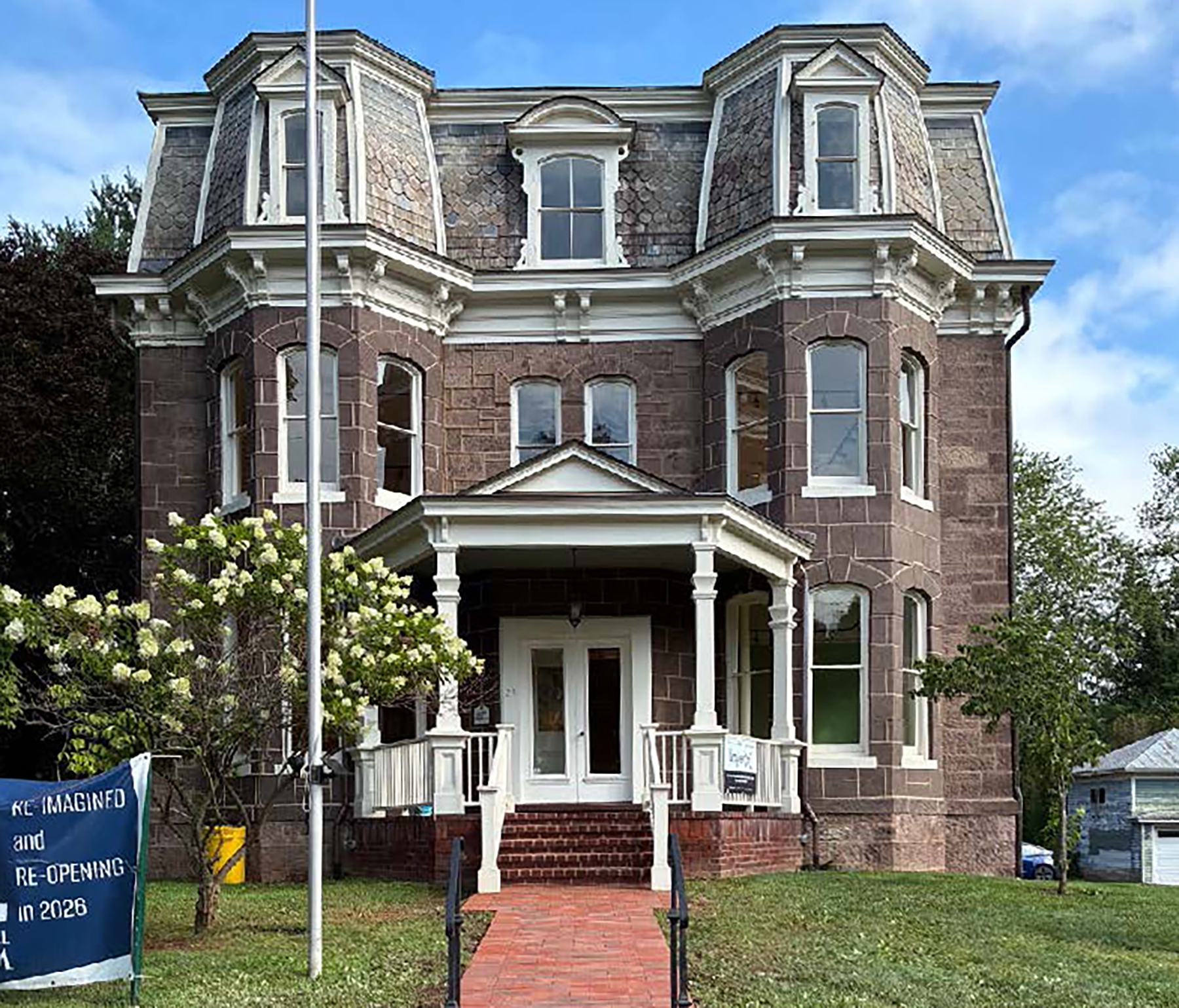
The Hopewell Museum is preparing to reopen in December following a sweeping renovation that has restored many of the historic details of its nearly 150-year-old home while adding modern systems designed to better protect its collections and serve visitors.
The museum at 28 E. Broad St. in Hopewell Borough has been undergoing the latest phase of a multiyear project dubbed “Reimagination,” an effort to preserve the historic building while transforming it into a modern museum and community space.
The Second Empire-style house, built around 1877 as the home of the Stout family, has served as the museum’s home since 1924. By 2018, however, its aging floors, windows, pathways and mechanical systems were showing their age, and museum officials determined that renovation could no longer be put off.
The museum’s current home is itself considered one of the most important pieces in its collection.
The Hopewell Museum traces its beginnings to 1922, when the Hopewell Free Public Library and Museum Funding and Building Association was incorporated to provide a home for a collection of antiques donated by Sarah D. Stout. The collection became the foundation of what is now the Hopewell Museum.
The museum began its Reimagination initiative in 2020, but the COVID-19 pandemic interrupted the work and forced the museum to close to visitors. Exterior restoration resumed in 2022, followed by work to conserve, catalog and store the museum’s collection.
The current $1.5 million third phase has focused on the building’s interior. LayerX Architects of Philadelphia developed the master plan, while Princeton-based C. Raymond Davis & Sons is serving as general contractor. The project includes redesigned exhibit spaces, new electrical and plumbing systems, improved heating and air conditioning and new museum-quality lighting.
Some of the most striking discoveries were beneath the museum’s feet.
In 2021, museum board members Mary Lynn Dupuis and Marcia Lowe pulled back part of the building’s aging carpet and discovered an ornate hardwood inlay that had been hidden for decades. The carpet was eventually removed throughout the building, exposing 19th-century parquet floors that have since been cleaned, coated and buffed.
The restored floors, with geometric patterns running through the rooms and hallways, are among the historic architectural features that will become part of the visitor experience when the museum reopens.
Restoring the building’s windows proved considerably more complicated.
“The skill that went into fixing these windows went way beyond what we had imagined,” project superintendent Nick Grasso said. “When we started, every window was sealed shut, corked shut, or nailed shut. All the hardware was painted over. All the chains to the weights inside the walls were painted. Nothing was usable.”
The project team brought in Chris Fullan of Forever Hung Windows in Bucks County, Pennsylvania, to restore 13 double-hung windows. Fullan disassembled the windows and rebuilt their mortise-and-tenon sashes, repaired the century-old hardware and reset the original wavy glass by hand before reinstalling each window in its original location.
Workers also restored the building’s plaster walls and three fireplaces while preserving irregularities and other traces of age rather than making the historic house appear newly constructed.
On the third floor, for example, plaster was formed to follow the existing contours of walls and alcoves. Some evidence of old stress cracks was deliberately retained as part of the building’s history.
Behind those historic surfaces, however, much of the museum is new.
The renovation included replacement of the building’s electrical and plumbing systems and a major overhaul of its heating, ventilation and air-conditioning systems. New equipment includes air handlers, central air conditioning and mini-split systems intended to improve climate control and indoor air quality.
For Grasso, opening the walls also provided a glimpse at how builders and electricians worked generations ago.
“For us to open up the walls and see how it was done so long ago — it’s ingenious what they did,” he said.
Among the systems uncovered was old knob-and-tube wiring, in which braided electrical wires were routed through porcelain components attached to the building’s framing. That system has now been replaced with modern wiring enclosed within the walls.
Lighting was another major consideration because the building must function not simply as a historic house but as a museum responsible for protecting fragile artifacts.
The renovation added energy-efficient LED fixtures and track lighting throughout the galleries. The movable lights can be repositioned depending on whether an exhibit contains artifacts, maps, photographs or other materials.
Museum officials have said the project is intended to strike a balance between preservation and modern museum standards. Plans announced earlier this year called for reconfigured exhibit areas capable of accommodating both permanent and rotating displays, while the third floor would be converted to office space.
The museum’s collection includes Native American artifacts, early tools and farm implements, needlework, American and Victorian furniture and textiles, china and glassware, documents, Civil War artifacts, photographs, maps and genealogical materials documenting Hopewell-area life from the pre-colonial period to the present.
Work leading up to the reopening also includes improvements to the grounds, exterior painting, new interior and exterior signage and repairs to the walkway leading to the front entrance. An ADA-compliant lift is being installed to provide access to the first floor through the museum’s west entrance.
Museum staff members are also developing the inaugural exhibit for the renovated galleries, which will bring together artifacts from the collection around a Hopewell Valley theme.
Future plans extend beyond the current renovation. A proposed fourth phase would add space at the rear of the building for archives and researchers, a meeting room, additional storage and an outdoor patio and garden. That phase is expected to be supported through a separate capital campaign.
For now, the museum remains closed to regular visitors, although research appointments are available at its temporary office at 43 Railroad Place. The museum’s official website says exhibits are scheduled to reopen in late 2026.
When those doors reopen, visitors will encounter a museum whose newest attraction may also be its oldest: the restored house itself.

