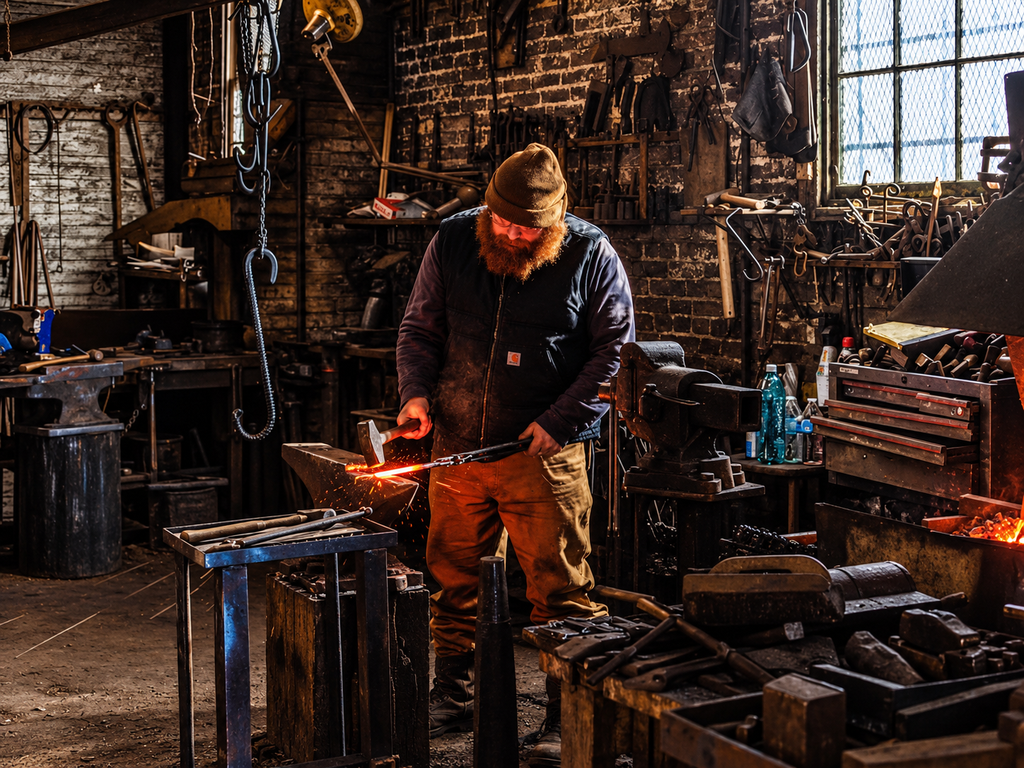
Local artisan Daniel Lapidow keeps an ancient craft alive in Trenton
Daniel Lapidow is a modern blacksmith practicing a craft that dates back thousands of years. Nicknamed the Hebrew Hammer by a mentor, he wears the label proudly, turning raw metal into everything from decorative artwork to functional tools and architectural ironwork.
Originally from Lawrence and now living in Ewing, Lapidow operates his independent business under the name Hebrew Hammer Blacksmith, creating custom metalwork, maintaining an online portfolio and traveling to craft shows and Renaissance fairs to demonstrate traditional blacksmithing techniques.
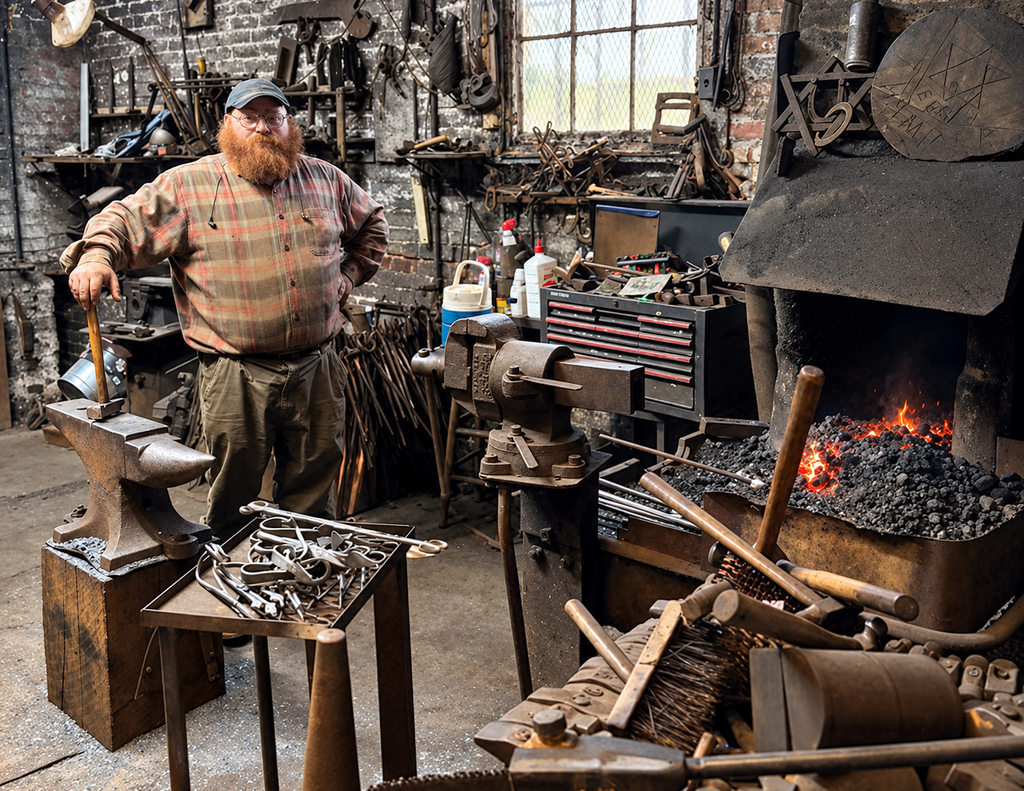
He also serves as a resident artisan at The Blacksmith of Trenton, a historic workshop on North Olden Avenue in Trenton that has been in existence since 1823. The shop has barely changed in that time, retaining its coal-fired forge, where traditional techniques are used to fabricate and repair metalwork for businesses and homes.
Blacksmithing is the working of iron, which is a “black” metal. Whitesmiths work with softer metals such as silver and gold. With a forge or furnace for heating raw metal, an anvil for working it and tongs and hammers for shaping it, a blacksmith gets to work.
With origins dating to 1500 B.C., when iron ore was first smelted and forged, blacksmithing was a staple of the economies of villages and cities. Today, blacksmiths are artisans, a link to the past and a window into a craft that was once vital and necessary.
1. What first attracted you to blacksmithing?
Blacksmithing came into my life at just the right time. I was 7 years old when I saw a blacksmith at Howell Living History Farm in Hopewell, New Jersey. I fell head over heels in love with the craft. At 7, I was diagnosed with dyslexia, and I needed to be able to do something that took my mind off school. I always say blacksmithing saved my life!
2. Were you artistic or interested in the arts prior to blacksmithing?
Yes, I always loved working with my hands. In this trade, strong hands and body are essential.
3. How did you get the necessary training?
You never stop learning this trade. But I did a lot of training with local smiths, going to craft schools and blacksmith meets. I knew that blacksmithing had to be part of my life. I have taken several blacksmithing classes at Tillers International Craft School, Peters Valley, John C. Campbell Folk School and the Adirondack Craft School.
4. Do you make custom work? Do you do any repair work?
I do a lot of custom work that involves reproducing old ironwork or fixing old tools. But most of my business is demonstrating my craft and selling my work at craft shows and Renaissance fairs.
5. Is it noisy, smoky and hot, as we imagine?
It is noisy and a little smoky. And in the summer, it can get very hot in the shop, but I would not trade it for any other job. I have the pleasure of working out of the oldest blacksmithing shop in New Jersey. The shop is called The Blacksmith of Trenton. It is run by “Sasha” Parubchenko, who is the blacksmith I began training with in my youth.
6. How large are the pieces you work on? Are assembly skills needed?
I do some big railings and have fixed some old gates. And yes, assembly skills are a must. I must be able to fabricate to ensure everything fits as desired for the job.
7. Who are some of your inspirations or influences?
I just love to make hot metal move and see what it wants to become. I like trying new projects to see if I can move in new directions. That is always fun. Seeing the work of other smiths gives me so much inspiration.
8. Do you make fun art pieces, or is everything for a purpose?
When I am not working on any other jobs, I will still be forging. Hitting hot metal is so fun.
9. What fight or struggle do you have regarding your art?
The business can be feast or famine when it comes to making money. So it takes a lot of self-discipline to make it work as a self-employed craftsman, and it is a lot of physical labor.
10. Tell us about the medieval shows and fairs. How did that come about? How many do you schedule per season?
I found myself getting involved in craft shows and Renaissance fairs at the start of my blacksmith business. A lot of the events reach out to me asking me to be part of their events. There are not a lot of smiths in my area. So I don’t look for shows on my own that much. I get asked to do events all the time, and fortunately, I can make a lot of them. I have my calendar booked up by the end of January every year.
11. What is your favorite work to do or pieces to make?
My career as a smith and the reputation I have made for myself are the favorite things I have made. Years in the making, and I am still learning.
12. What is the most fun about your craft?
Even though it is physical labor and there can be long days in a hot workshop, I get to make my living playing with fire and hitting things with a hammer. How fun is that?
13. What is your dream project?
I would love to get together with a group of other Jewish smiths and have us all forge a big Hanukkah menorah.
14. What is on the horizon? What are you looking forward to?
To be able to travel all around the USA doing Renaissance fairs and be making enough money so that my fiancée can work with me full time. That would be awesome!
Hebrew Hammer Blacksmith, operated by Daniel Lapidow, offers custom metalwork, repairs, blacksmithing demonstrations and educational programs. Lapidow works at The Blacksmith of Trenton, 334 N. Olden Ave., Trenton. For more information, call 609-396-9583 or visit hebrewhammerblacksmith.weebly.com.
Hebrew Hammer Blacksmith, operated by Daniel Lapidow, offers custom metalwork, repairs, blacksmithing demonstrations and educational programs. 609-396-9583. Lapidow works at The Blacksmith of Trenton, 334 N. Olden Ave., Trenton. For more information, visit hebrewhammerblacksmith.weebly.com.