

In May 1778, British troops were forced to evacuate Philadelphia after heavy fighting with Continental troops. Upon doing so, they marched across New Jersey to Sandy Hook with the expectation that their ships would provide safer passage to New York City, where much of their army was stationed. Along the way, the caravan of 17,000 soldiers, with 2,000 women and children in tow, was continually met by American forces that caused chaos at every turn.
Along the Delaware River at White Hill and Bordentown, the Pennsylvania Fleet scuttled its vessels to prevent them from falling into enemy hands. Two companies of American militia greeted the troops on Burlington Road with a volley of cannon fire and retreated into Bordentown. Not taking kindly to this gesture, the advancing troops set fire to American vessels moored along the banks of Crosswicks Creek near town.
The following month, Gen. Sir Henry Clinton, accompanied by Gen. Lord Charles, Earl Cornwallis, and his division, ordered the 16th British Regiment of Light Dragoons to destroy the bridge over Crosswicks Creek (presently on Route 206) that was guarded by the New Jersey militia. Later, another bridge that spanned Crosswicks Creek to the east of town (presently on Route 130) was captured by Lt. Col. John Graves Simcoe’s Queen’s Rangers after a fierce engagement with the 2nd New Jersey Regiment. These were not the only casualties of the time, as death and destruction left a bloody swath in their wake.
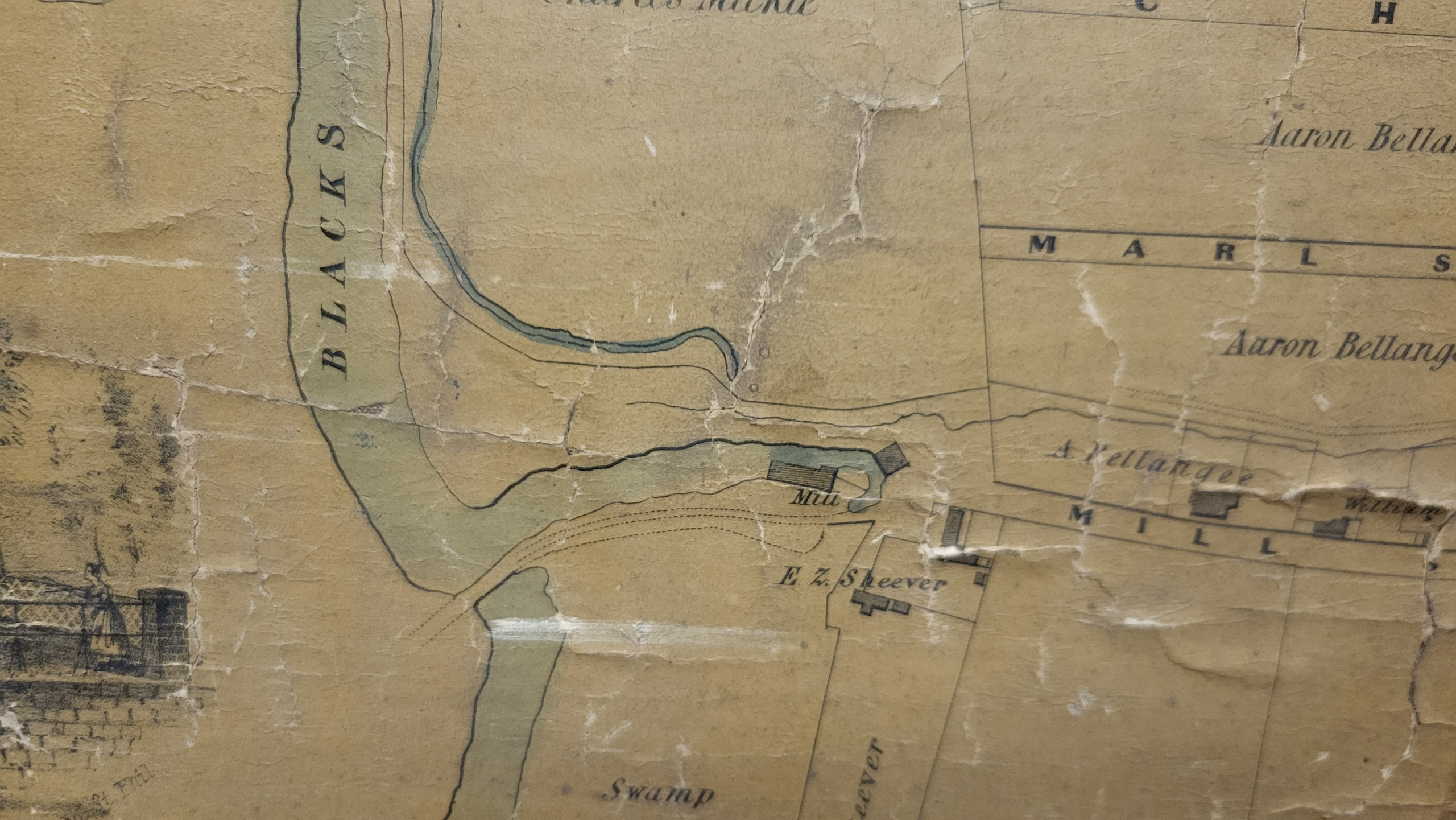
To the south of Bordentown stood a four-story gristmill over Black’s Creek. Constructed by Nathaniel Lewis in 1772, it was considered one of the largest mills in New Jersey. The first floor was constructed of stone and contained a kiln for drying corn, as well as machinery needed for the sawmill operation. All of the millstones in the structure were set on this floor. Due to the size and location of this mill, it became a convenient target for the British to plunder.
A Hessian captain by the name of Johann Ewald and his trained troops, known as Jägers, patrolled ahead of Cornwallis and his three regiments to secure the uneasy terrain and quell any local hostilities. This was not an easy achievement, as the sweltering air was thick with biting flies that thrived among the plants in the soft, stagnant mud that could swallow a boot without forgiveness.
The reward for such misery was to secure sacks of grain and corn and load them onto their wagons. Farm animals were removed for the sake of protein. Although acting under military orders, Ewald felt remorse for his actions, as he had quartered with the Lewis family during the Hessian occupation of Bordentown in December 1776. This experience was later noted in his private journal.
However, the following morning, the ultimate insult occurred as departing enemy troops were ordered to set fire to the hulking structure. Like a Roman candle, smoke and flames from the crackling timber lit up the sky. Thankfully, the stone walls of the first floor protected much of the machinery. In time, the property and remnants of the mill were sold to Amariah Farnsworth, a relative of Thomas Farnsworth, the first known settler of Bordentown.
Eventually, the mill was rebuilt and operated for many years under different owners. According to property records, Isaac Shreve was listed as one of the last owners before nature reclaimed the site and the millstones sat idle.
Surprisingly, the story doesn’t end here. In 1880, a local businessman and descendant of Isaac Shreve named William Shreve established Bordentown’s first coal and lumber yard on Third Street. Coal generated a growing economy, as households and stores depended on it for heating. In addition, Shreve treated customers with dignity and respect while serving as a director of the Bordentown Banking Company.
At some point, coal and lumber weren’t the only materials deposited on the property. Resting on the ground were the ancient millstones that had once been key components of the Lewis mill. Although it’s difficult to speculate when they arrived, they were preserved for posterity nonetheless.
By all accounts, these are known as French buhrstones, which were quarried in the Marne Valley near Paris, France. Prized by millers for their exceptional wheat-grinding abilities, each stone is porous, containing multiple cavities left by fossilized shells. Yet the hardness of their sharp edges allows them to separate and shear unwanted bran from the meal, creating a fine white flour.
The stones are cut into irregular blocks, pieced together like a jigsaw puzzle with pie-shaped sections, and bound with an iron band. When used properly, French buhrstones could last for a generation or even longer.
Thankfully, the Bordentown Historical Society was able to rescue five French buhrstones from the former Shreve property (and later J.M. Reeder Company) before renovations to the existing buildings. Each stone was numbered, tagged and taken to a safe location until the stones could be reassembled and displayed in a public area.
Bordentown’s past is full of history, including the 20-year self-imposed exile of Napoleon’s oldest brother, Joseph. Now the legacy of the millstones will become part of that French connection, as well as a tangible symbol of the town’s turbulent period during the Revolutionary War.
Something to think about … or should I say, “Grist for the mill.”

