

By Paul Ligeti
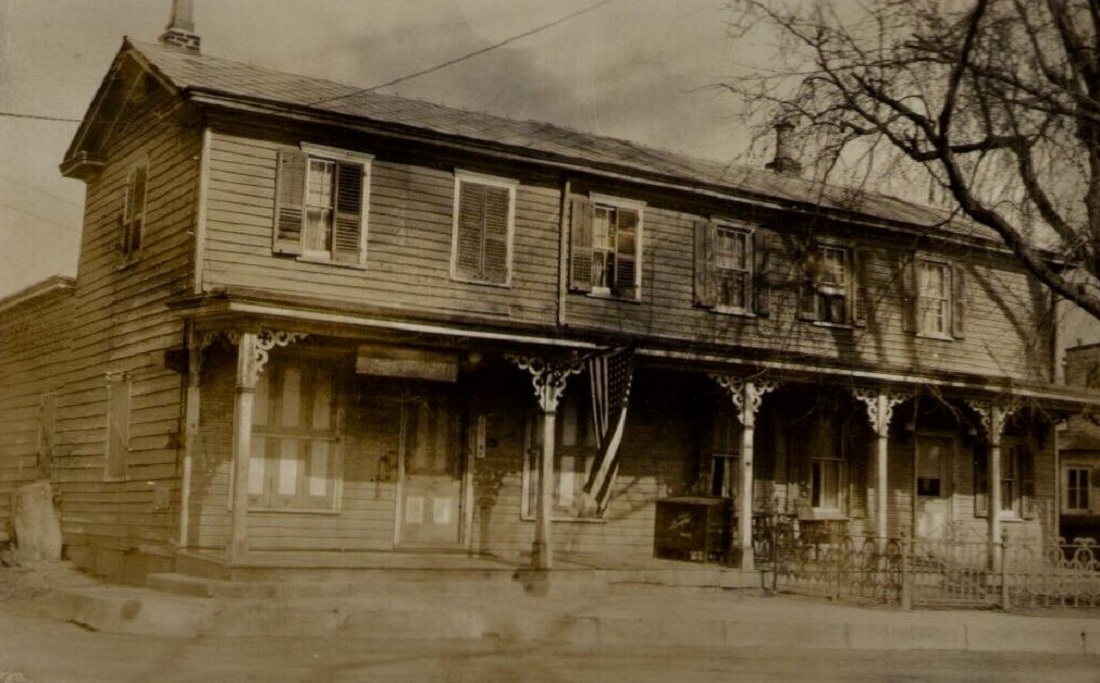
In this article, we explore the history of the old Dutch Neck general store and post office, now a private residence at 420 Village Road East, but still replete with history.
Standing near the intersection of South Mill Road and Village Roads East and West, in the historic Dutch Neck community, is a long, two-story building. Now a private home, its appearance gives only limited indication of the role it once played in the surrounding community. However, for well over a century, the building housed the Dutch Neck general store and, for much of that period, the village post office. Later, as West Windsor changed from a largely agricultural township into a suburban community, the old store was adapted for many other commercial uses.
The building probably dates to at least the first half of the 19th century, if not earlier. Visual analysis suggests it may have begun as a smaller building and been enlarged over time. The property itself had earlier formed part of a much larger farm owned by the Voorhees family. However, in 1819, they sold two acres to Joseph and Mary Mount. Ownership changed repeatedly during the following years before Jonathan and Angeline Robbins acquired the tract in 1833.
Jonathan is the first person clearly documented as operating a store at the site, but a store may have existed there earlier. An 1834 directory reported that the Dutch Neck hamlet had a tavern and several stores, although it is uncertain whether the building at 420 Village Road East was among them.
In any case, by 1851, a post office had been established in this building, with John S. Robbins as postmaster. For a farming village in the era before automobiles and telephones, stores often doubled as post offices. A later description of Dutch Neck in 1875 called the settlement a “thriving little village” with one general store, along with a wheelwright shop, blacksmith shop, hotel, school and Presbyterian church.
Jonathan Robbins sold the store and the neighboring house at 418 Village Road East to Enoch Forman in 1854. By 1868, the store had become a separate property, and ownership passed through several hands. Jonathan W. Hooper held it briefly, followed by John and Adaline Savidge. The 1870 census identified Savidge as a dry-goods merchant. Chester and Sarah Pullen owned the property from 1872 to 1874, after which William Allen acquired it. Allen, who remained associated with the property until his death in 1890, was listed in the 1880 census as a produce dealer.
The property passed to Isaac V. Hey in 1892, although Hey apparently was not its principal merchant. That role instead fell to Frank Adams, who also served as Dutch Neck postmaster. Accounts indicate that Adams operated the establishment for more than four decades, apparently continuing until his death in 1933. The store of this period served the broad needs of an agricultural community, with goods ranging from clothing and stationery to farm-related supplies, medicine, ice cream and ice skates.
After Adams’ death, Abe and Esther Shtier operated the store for roughly 15 years. The post office, however, became less firmly tied to the building. It moved across Village Road to the home of Alice Smallbone and reportedly remained there until about 1949. It then returned to the general store for several years, shifted to Hannah Tindall’s house at 408 Village Road East, and later returned again to the store.
The Rifkin family began operating the establishment around 1957. By then, its inventory included groceries, jewelry, clothing, hardware, cosmetics and medicine, while those who grew up in the area still remember it as a place to purchase candy, soda and snacks.
In 1966, the Dutch Neck post office permanently closed after more than a century of service. Mail delivery for the area was transferred to the Princeton Junction post office. This was a time when West Windsor’s accelerating suburban development required larger, more central facilities to serve the township’s growing population.
The building did not immediately cease commercial use. Instead, the late 1960s and 1970s brought an unusually varied succession of businesses. Among the first was the Sewing Basket, operated by Rose Zinetti during the mid- to late 1960s. Key Data, a data-processing company, also occupied the building during the latter part of that decade.
Another tenant was Village Hobby, operated by Bill Miller. The shop sold models, toys and other hobby supplies and remained in business until approximately the early to mid-1970s. During that decade, the building also became home to the Pizza Pan, a pizza parlor that operated for much of the 1970s. At another point, Wesley Holman operated a deli there. Dance Spectrum operated a dance school or instructional studio in the building’s rear wing and apparently continued into the 1980s.
Eventually, commercial use ended, and the building was converted to a private residence. Alterations over the years have changed its appearance. Several windows and a former front doorway have disappeared, its elaborate historic porch is long gone, and the one-story rear extension was demolished many years ago. The main two-story portion, however, survives at 420 Village Road East as one of the historic buildings associated with the old Dutch Neck community.
The Historical Society of West Windsor is an all-volunteer community nonprofit. Every one of us donates our free time, without pay, to document and promote our township’s shared heritage. But we need community support. Please consider volunteering; visit westwindsorhistory.com.Proofing notes
Paul Ligeti is the president of the Historical Society of West Windsor.

