

By Ellie Harris and Bill Sanservino
Robbinsville Public Schools officials and residents got an unpleasant surprise just weeks before the start of the new school year.
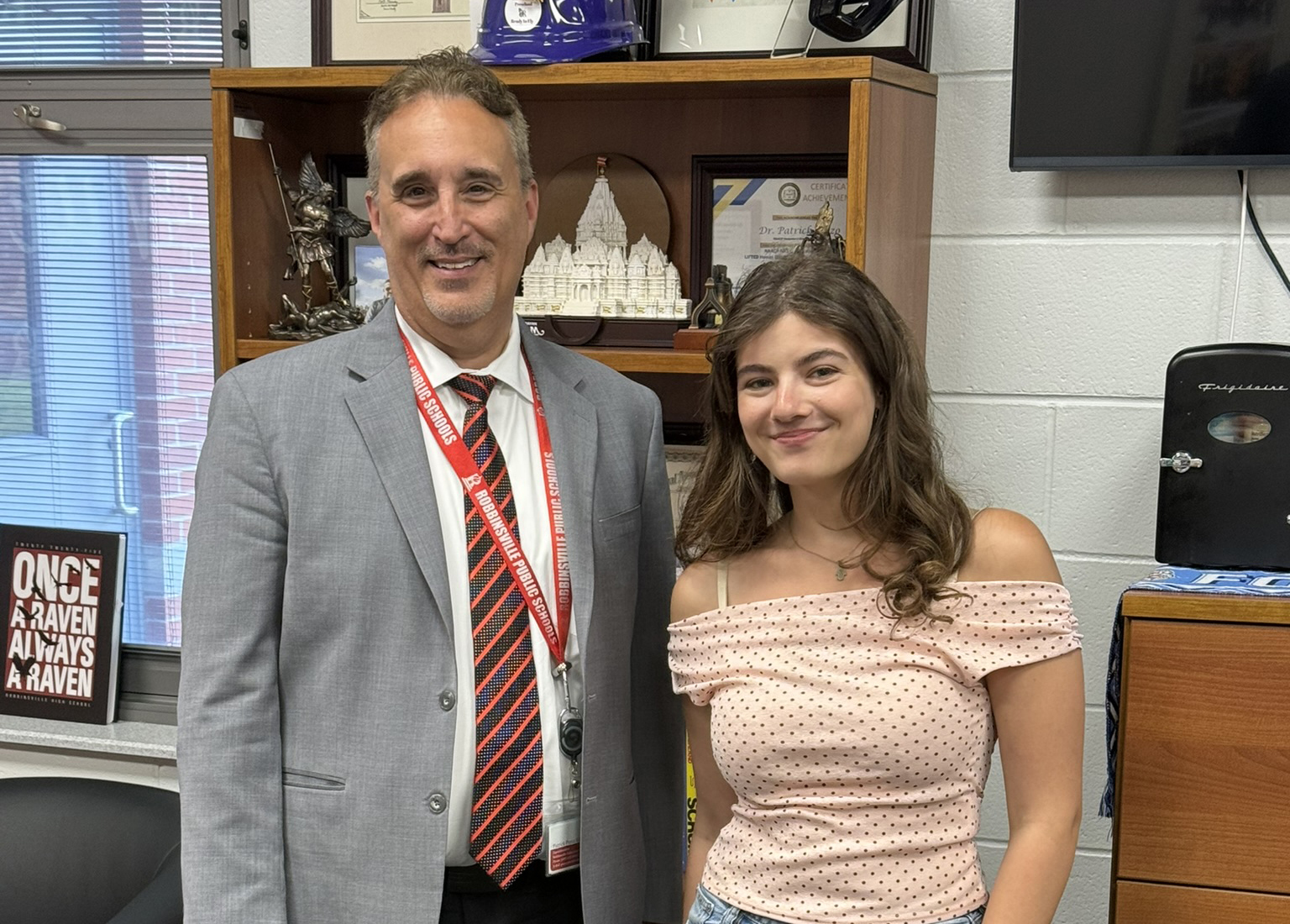
Superintendent Patrick Pizzo unexpectedly resigned less than two years after taking over the district and as Robbinsville continues to grapple with significant financial and leadership challenges.
The district announced Aug. 19 that Pizzo had resigned effective Aug. 20. Assistant Superintendent Kristy DeFazio became acting superintendent Aug. 21.
“The Board thanks Dr. Pizzo for his service to the district and wishes him well in his future endeavors,” the board said in a brief statement.
The board did not give a reason for Pizzo’s departure or provide details about the circumstances surrounding his resignation.
Pizzo became superintendent Jan. 1, 2025, succeeding interim Superintendent Jeffrey Gorman, who had served following the 2024 retirement of longtime Superintendent Brian Betze.
Before coming to Robbinsville, Pizzo had a long career in education in New York and served as assistant superintendent for business and finance and chief financial officer for the East Meadow School District.
His departure comes as Robbinsville prepares for another difficult school year following a failed $5.03 million tax referendum, about $2.4 million in cuts to the 2026-27 budget and continuing concerns about how the district will balance future budgets without further reductions to programs and staffing.
It also comes only weeks after Pizzo was publicly discussing plans for the coming school year and emphasizing the importance of communication and transparency with residents.
There was no indication in a lengthy June interview with the Robbinsville Advance, or in columns Pizzo wrote for the newspaper in June and July, that he was preparing to leave the district. Instead, Pizzo repeatedly spoke about work he intended to continue in the coming school year and the longer-term financial challenges he expected to address.
At the end of the June interview, Pizzo was asked whether he planned to continue writing his monthly Robbinsville Advance column. He said he was honored to do so and spoke about how much the opportunity to communicate through the newspaper meant to him.
In his June column, Pizzo wrote that trust grows when residents see that their school district is “reaching outward, inviting questions, and welcoming scrutiny as we tackle difficult budget decisions.”
“Communities do not lose faith in their schools because of hard times; they lose faith when they feel left in the dark during them,” Pizzo wrote.
He ended the column by saying, “The columns will continue. So will the conversation.”
In his July column, Pizzo acknowledged what he called a challenging year in which the district made “hard calls” affecting programs, staffing and services.
Looking ahead, he said communication, transparency and trust would remain central to the district’s work.
“These aren’t just values we post on a wall; they’re operating principles,” Pizzo wrote. “In moments of challenge, they matter more, not less.”
He also wrote that while challenges would remain in September, he was confident the community could move forward with “purpose, integrity, and an unwavering commitment” to students.
Those challenges will now fall largely to DeFazio and, eventually, whoever is selected to permanently lead the district.
In March, Robbinsville voters rejected the a $5.03 million referendum by a vote of 2,022 to 1,503, or about 57% to 43%. The ballot question would have allowed the district to exceed New Jersey’s 2% property tax levy cap to address what school officials described as a structural deficit and preserve academic programs, student services, athletics, clubs and staffing.
After its defeat, the district moved ahead with reductions that included cuts to teaching and other student-facing positions, mental health services, sports, clubs and courtesy busing.
School officials had already eliminated roughly 30 positions over the previous three years as it attempted to close earlier budget gaps.
In a June interview with the Robbinsville Advance, Pizzo said the district had reached the point where virtually any additional reductions would affect students.
“We’re at the point now with our cuts, there is no area to cut that doesn’t directly impact our students,” Pizzo said.
He cited approximately $400,000 in mental health reductions, cuts to middle and high school sports, the elimination or reduction of clubs and about 15 additional positions that had been eliminated or left unfilled as the district worked to close the latest budget gap.
The high school swim and golf programs were among the sports affected, with supporters looking at fundraising as a way to preserve them. Pizzo said the swim team faced a fundraising goal of about $60,000 and golf about $30,000.
He said fundraising could help preserve programs in the short term, but questioned whether relying on private fundraising could provide a sustainable solution year after year.
Pizzo also raised concerns about equity when programs depend on families or community groups raising enough money to support them. He said public education was not intended to operate on an “a la carte” or pay-to-play basis in which students from families or groups with greater resources had access to opportunities that others did not.
At the same time, the district was pursuing donations, partnerships, building rentals, advertising and other sources of revenue.
Pizzo said the administration was looking at nearly every possible way to bring additional money into the schools, from working with the Robbinsville Education Foundation and parent groups to exploring business sponsorships and advertising.
“We’re trying to do everything we can from every angle,” Pizzo said. He said the district had identified about $7 million in cost avoidance and efficiencies, including projects such as solar installations, while also looking to raise revenue through greater use of school buildings.
He also described efforts with Mayor Mike Todd to seek changes at the state level involving debt service, state aid and funding for mandated special education services.
Pizzo said state aid had been declining by about 3% annually and could fall further.
The district’s relationship with the township had become another part of the strategy.
During the interview, Pizzo described working closely with Todd on school-related costs and the effects of payments in lieu of taxes, commonly known as PILOT agreements. He said the township had taken on additional costs involving crossing guards, school resource officers and infrastructure improvements related in part to the elimination of courtesy busing.
Pizzo said the district and township faced some of the same financial pressures, limiting how much one government could shift to the other.
The district’s financial problems, he said, were not expected to end with the 2026-27 budget.
He said he was already focusing heavily on 2027-28.
“We need to get our ship in order for 27-28,” he said. “I’m looking at 27-28 as often as I’m looking at 26-27 at this point.”
He described what he viewed as a fundamental mismatch between the growth in school expenses and the amount of additional revenue available under the state tax levy cap.
Pizzo said Robbinsville’s school costs were increasing roughly 3.5% per year, while the 2% levy cap applies only to the portion of district revenue raised through local taxation. By his calculation, that meant local revenue growth amounted to about 1.55% of the overall budget while costs were growing at more than twice that rate.
He also said that over a 13-year period, Robbinsville had remained below the permitted tax cap in 10 years, was flat in another and actually reduced the levy in one year.
Once reserves and other efficiencies are exhausted, Pizzo said, budget reductions increasingly reach classrooms and student services.
“People look at school budgets and they think we have a lot more discretionary than it is,” he said during the interview.
Pizzo said school districts are fundamentally personnel-driven operations because education depends heavily on teachers and other employees. As a result, he said, eventually a large budget reduction means reducing staff.
During that discussion, Pizzo made a comment that has taken on added significance following his resignation.
“If all of our budget problems would be solved by me leaving, I would leave,” Pizzo said.
He immediately made clear that he was making a point about the scale of the district’s budget problems, not announcing an intention to resign. Pizzo said eliminating a superintendent’s salary would be “a drop in the bucket” compared with a multimillion-dollar budget gap.
At the time, Pizzo projected that Robbinsville could face at least a $1.6 million shortfall for 2027-28, and potentially another gap closer to the roughly $2.2 million the district was addressing in the current budget cycle.
“If absolutely nothing goes wrong and our state aid isn’t cutting more than what it was this year, we’re looking at a deficit of 1.6 million,” he said. “I believe that it’ll probably be closer to 2.2 million.”
Pizzo said the district ultimately has only two ways to close such a gap: increase revenue or reduce expenses.
Robbinsville cannot operate at a deficit, he said, meaning the difference eventually has to be removed from the budget if additional revenue cannot be found.
“Best case scenario, we gotta cut $1.6 million next year,” Pizzo said.
He said that could mean fewer programs, fewer teachers and larger class sizes.
Pizzo said elementary class sizes were already approaching 25 students and could rise further if the district remained on its existing financial path.
Another referendum remains one potential option for future district leadership, although Pizzo said in June that he would not support immediately returning to voters simply because the first question failed.
The district would have another opportunity to place a question before voters in 2027, he said, but only if there were clear community demand for it.
“The only way we do another public question is if the public demands it,” Pizzo said. “They voted no. No was the answer.”
He noted that the March referendum failed by approximately 500 votes and said another attempt would make little sense without a significant change in community sentiment.
“If we voted today, we’d fail again,” Pizzo said at the time.
The leadership transition also comes after Robbinsville had already reduced the size of its central administration.
Pizzo explained in June that after an assistant superintendent left, the district combined administrative responsibilities rather than filling every vacant position.
DeFazio became assistant superintendent for curriculum and instruction, with Pizzo describing the restructuring as taking three administrative positions and turning them into two.
Pizzo said he preferred eliminating an administrative job rather than a teaching position whenever possible, but cautioned that there were limits to how far the district could reduce its management structure.
“We’re very lightly staffed administratively, as well we should be,” Pizzo said. “We wanna be as lean as possible.”
But he added that becoming too lean carries its own costs.
“The problem when you get too lean is you make mistakes,” Pizzo said, adding that having fewer people seeking grants, efficiencies and other funding opportunities can ultimately result in fewer resources reaching classrooms.
DeFazio now assumes the district’s top position while continuing to face many of the pressures Pizzo described.
At another point in the June interview, Pizzo was asked whether children currently enrolled at Sharon Elementary School could expect the same level of opportunity as students who had moved through Robbinsville schools before the recent cuts.
“I’m still here and I’m fighting,” Pizzo said. “So as long as I’m here, I believe that we’re going to get there.”
Pizzo had also planned to continue monthly “Community Conversations” during the 2026-27 school year, giving residents opportunities to ask questions about district finances, programs and other school issues.
He said in June that the forums would allow residents to ask him about virtually any school issue and that he would either answer immediately or provide a detailed response later.
His goal, he said, was to help residents understand the consequences of operating the district with fewer resources.
“There’s an expression, do more with less,” Pizzo said. “Well, unfortunately you get to a certain point you’re gonna do less with less.”
The lack of explanation surrounding his resignation quickly generated questions from residents on social media, particularly because of the timing and a recent history of turnover among senior district administrators.
Former Robbinsville Mayor Dave Fried, who left office because he was moving out of the township earlier this year, said the resignation should be viewed in the context of the district’s broader problems.
“At some point, leadership has to be accountable for results,” Fried wrote. “In just the last few years, Robbinsville Schools have faced significant senior staff turnover, serious budget problems, a failed referendum, the departure of the Business Administrator, and now another Superintendent leaving.”
“These are not isolated events anymore. They are a pattern,” he said while calling for greater accountability from the Board of Education. He suggested its president should step aside.
“Robbinsville has great teachers, great families and great kids,” Fried wrote. “They deserve stability, accountability and a fresh start.”
Other residents questioned why Pizzo left so close to the beginning of the school year and why the board provided no explanation beyond announcing that he had resigned.
Some asked whether Pizzo had resigned voluntarily or had been let go, while others questioned whether he would be paid for the remainder of his contract and whether taxpayers were entitled to more information.
Other comments focused on the timing of the departure and on what residents described as a broader pattern of turnover, budget problems and instability at the top of the district. Some called for greater accountability from the Board of Education and more scrutiny of school finances.
Not all of the reaction was critical. One commenter noted that superintendent moves can have a “domino effect” and that school leaders, like employees in other professions, may make career decisions based on what works best for them. The commenter added that budget cuts and disappearing funding have made the job more difficult and that, regardless of the reason for a leadership change, “the kids suffer the most.”
The Board of Education has not announced how long DeFazio is expected to serve as acting superintendent or provided a timetable for selecting the district’s next permanent superintendent.
Whoever ultimately takes the job will inherit more than the immediate task of guiding Robbinsville through a new school year.
The next superintendent will also inherit a district that Pizzo himself described only two months ago as having little room left for cuts, a reduced administrative staff, fewer student programs, continuing pressure on class sizes and another potentially significant budget gap already looming in 2027-28.
And the new leadership will have to decide how to address those problems in a community that rejected the district’s most recent request for additional taxes, while rebuilding the communication, transparency and trust that Pizzo repeatedly said were essential to getting Robbinsville through its financial challenges.

