

By Ellie Harris
In recent years, artificial intelligence has infiltrated schools across the country. This new technology has fundamentally and maybe permanently changed the way students learn and classrooms operate. All over the country, students have fallen victim to the ease of artificial intelligence models readily available to everyone on the internet.
AI models such as ChatGPT, Claude and Gemini, which is available for use on Google Drive platforms such as Google Docs, have the ability to research on behalf of the user, provide answers to supposedly any question they are asked or even generate text that users may then attempt to pass off as their own words.
To put it simply: The academic process students go through during their time in high school is monumentally different from what it was only a few years ago, and Robbinsville High School is no different from any other academic institution with internet access.
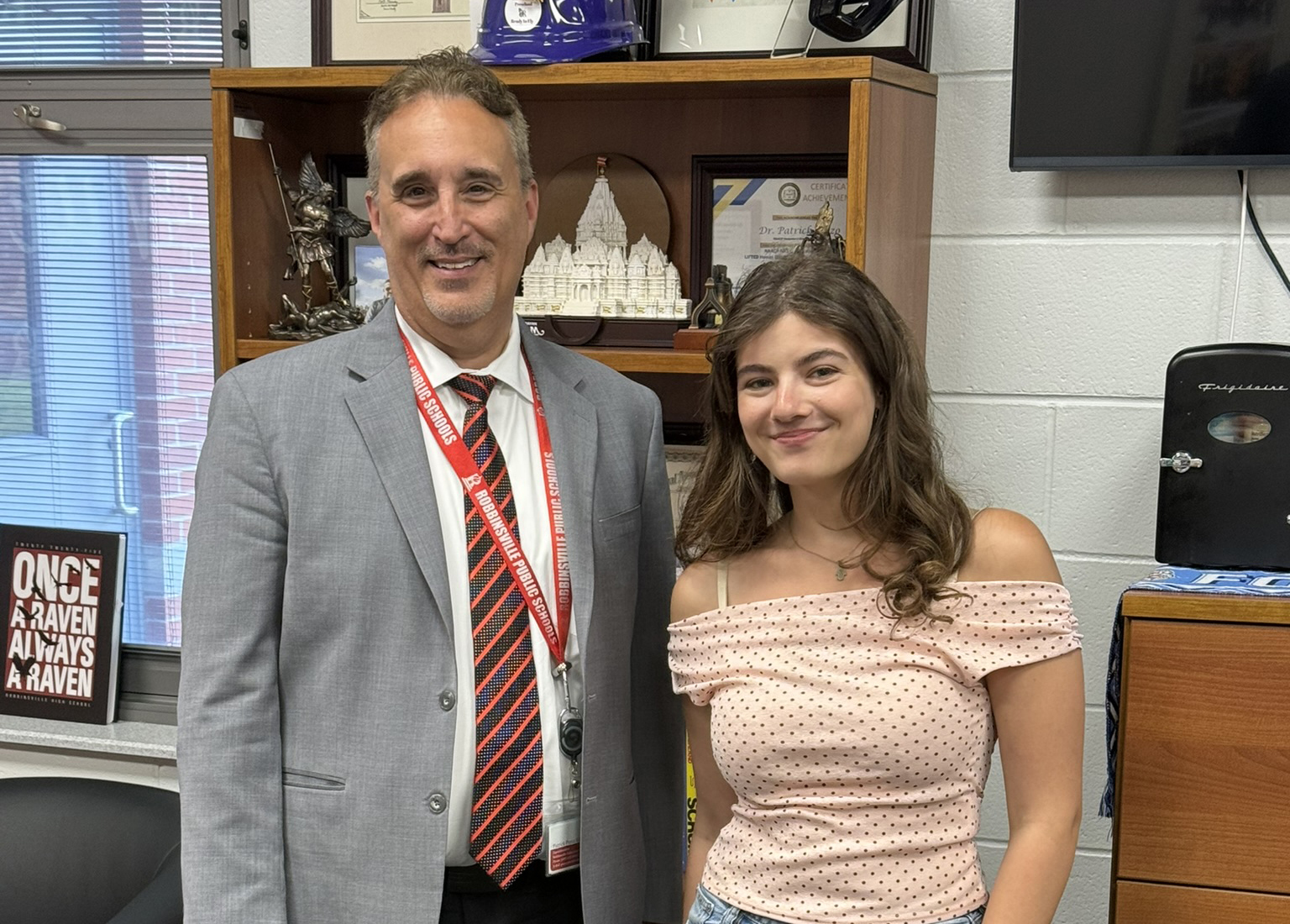
In an interview with Robbinsville High School history teacher Keith Armstrong, my former teacher as well, we discussed the sudden changes he has been forced to adjust to in his classroom.
Having been his student three years ago as a junior at Robbinsville High School, before I graduated in 2024, I did not experience the majority of the struggles he describes from the 2025-26 school year. As a junior in college, my experience with artificial intelligence in academics has thankfully only started when I was on the cusp of adulthood.
Armstrong, who teaches world history at the honors and Advanced Placement levels to juniors and seniors, told me that the majority of his students have adapted their academics to rely on artificial intelligence, and many go as far as having an app for ChatGPT on their cellphones for easy access.
His current students were in middle school when current popular models were being introduced into mainstream academics and popular culture. In the two school years since I graduated from Robbinsville High School, he has observed that the student culture surrounding artificial intelligence is akin to smoking.
Teenagers using either are enjoying the short-term benefits without understanding the long-term costs. He also said that some employees in the school district follow the same logic.
“A Wild West Period”
Artificial intelligence has become one of the fastest-growing technological advances of the 21st century and is unique in its inability to be legislated at a federal, state or district level, going all the way into our public school policy. Clear legislation for a version of artificial intelligence would need to be rewritten to accommodate the speed of the advances. The task is daunting.
Artificial intelligence has many faults, including being environmentally disastrous on a large scale and having unclear regulations regarding plagiarism. It is also uncontainable and easily accessible.
Artificial intelligence has found a home in academics across all stages. It has some uses for science, technology, engineering and mathematics, or STEM, classes but has been a nuisance for many writing- and discussion-based humanities courses, such as the ones Armstrong teaches.
Students’ abilities to double-check the answers to their math homework may be fine, but the same model they are using for math homework claims to be able to think for them, or at least generate ideas or passages for students to claim as their own.
To counter this dishonest use of artificial intelligence in his classroom, Armstrong has reverted to handwritten assignments for the upcoming school year, as well as requiring a notebook for handwritten notes taken in class.
Current high schoolers were not babies when publicly accessible artificial intelligence was introduced into their lives, but they were young enough that they do not know how to question results they receive when prompting a model. Artificial intelligence is not foolproof, and Armstrong has observed students failing to notice obvious mistakes.
“Is it using me or am I using it?”
This is the question Armstrong would like his students to ask when engaging with artificial intelligence. He believes that in our contemporary and unregulated age, users can act either as “passengers” or “drivers” while engaging with artificial intelligence, but complete avoidance is nearly impossible.
To be a passenger is to stop your research into a topic after reading the automatic AI overview provided by Google after searching a question or to only take music recommendations from a playlist made for you with artificial intelligence operated by a platform such as Spotify. Acting as a driver of artificial intelligence could mean giving a model direct instructions, therefore maintaining autonomy.
“AI doesn’t feel like breaking the rules.”
Since Robbinsville High School, like many other school districts, has been unable to create a clear and cohesive policy on artificial intelligence that can be agreed upon among all subjects and disciplines, the responsibility to create rules has fallen to teachers.
Students may go from an algebra class where artificial intelligence is encouraged for the benefits it provides in a STEM environment to an English class where its use may result in an automatic failure. The confusion this creates, in addition to the reality of students often having greater literacy with new technology than teachers, can lead to students accidentally cheating.
Armstrong said that using artificial intelligence in schools may be considered cheating in some classrooms but does not have the same stigma as copying a friend’s work and therefore does not force students to question the morality of “cheating.”
Artificial intelligence has just begun to challenge schools. In an internet-connected world, it is everywhere. Schools cannot avoid their students using models such as ChatGPT, especially since clear policies have proved to be so difficult to write.
In coming years, children will need an education on using artificial intelligence, and in addition to their parents, schools will have a responsibility to teach students to use artificial intelligence ethically.
In the meantime, teachers like Armstrong will work to do their best to help students learn with as little invasive artificial intelligence as they can manage.
Elizabeth Harris has been a Robbinsville resident her entire life and went to all three Robbinsville schools growing up before graduating from Robbinsville High School in 2024. Currently, she is 20 years old and a junior at Brandeis University in Waltham, Massachusetts, where she is studying American studies, international and global studies, and journalism.
Harris spent the summer as an editorial intern at Community News Service. A Robbinsville native and graduate of Robbinsville High School, she is a student at Brandeis University. After graduating, she plans on pursuing a career in journalism.

