

By Marisa Bozarth
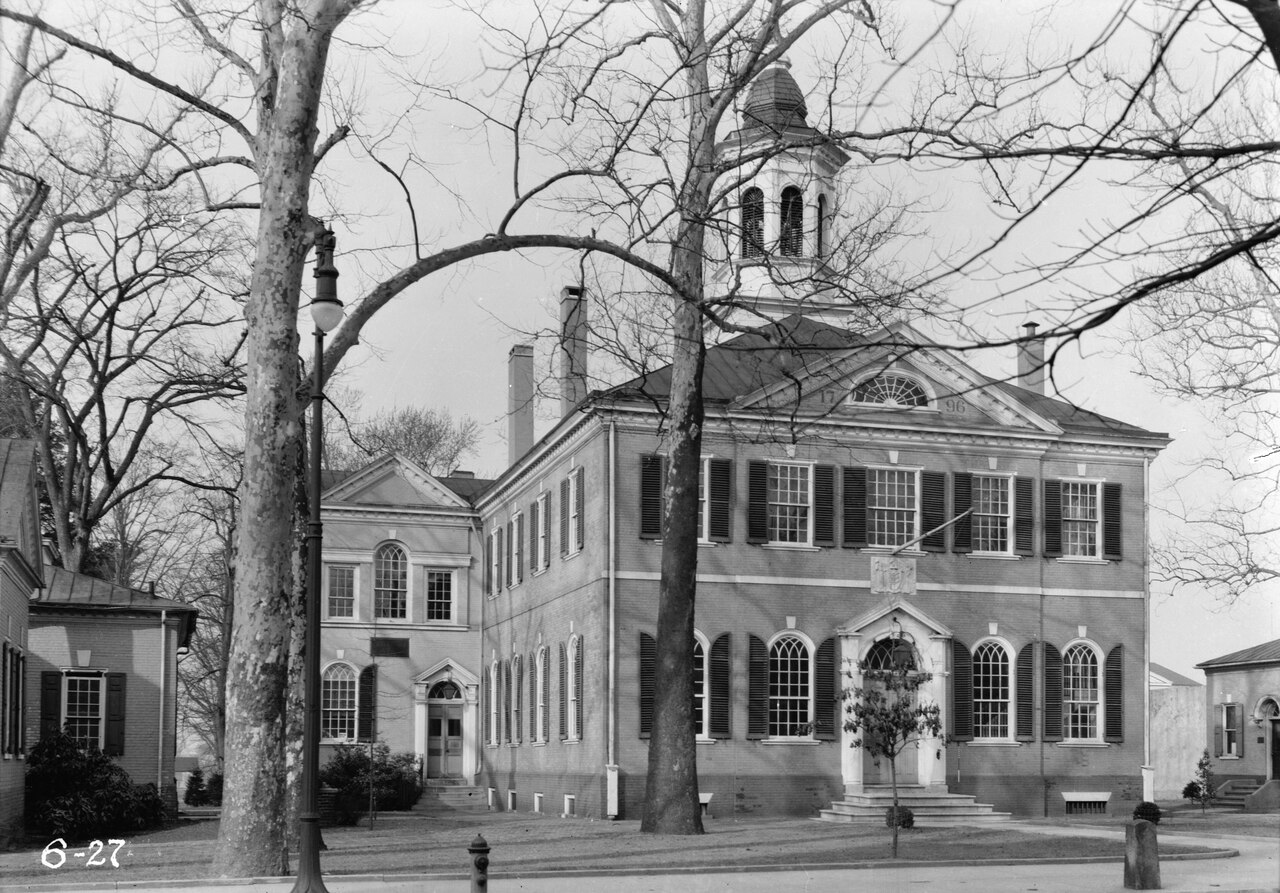
The Old Burlington County Courthouse stands as one of the oldest continuously used courthouses in the United States and serves as a remarkable symbol of Burlington County’s civic and judicial heritage.
The story of the courthouse begins with the original Burlington County Courthouse in Burlington City, constructed in 1693. After 100 years, the building had fallen into disrepair, and the state authorized a referendum to fund a new courthouse if a vote was held to determine its location.
As the county grew and population centers shifted inland, many residents sought a more centrally located county seat. In February 1795, Burlington County voters approved the relocation of the county government from Burlington City to Mount Holly. Residents of Burlington City were upset, beginning a generation-long feud between residents of Burlington City and Mount Holly.
A key figure in securing the courthouse’s new location was Joseph Powell, who helped facilitate the acquisition of land for the new public building at a cost of £210. Joseph Budd, a tavern and mill owner, was tasked with overseeing construction. He settled on Philadelphia architect Samuel Lewis, whose plans closely resembled Congress Hall and Old City Hall, the two buildings that flank Independence Hall in Philadelphia.
Lewis created an elegant Federal-style structure that reflected the ideals and aspirations of the young American republic. Construction was supervised by master builder Michael Rush.
The courthouse was completed in 1796. The first case heard within its walls was Jeremiah Pickering v. John Butterworth. The case was a debt claim against John Butterworth, who withdrew and ultimately agreed to pay the debt owed to Pickering. This case marked the beginning of more than two centuries of judicial proceedings conducted in the building.
The Old Burlington County Courthouse is regarded as one of New Jersey’s finest examples of Federal architecture. Constructed of brick with marble detailing, the building features a symmetrical facade, arched windows, decorative shutters and an elegant central entrance crowned by a fanlight. An octagonal cupola sits atop the structure. The balanced proportions, classical ornamentation and refined details reflect the influence of late 18th-century American civic architecture.
Among the building’s most notable decorative elements is the marble coat of arms over the front entrance. This impressive feature was donated by Isaac Hazlehurst, a prominent Philadelphia merchant who built a country estate at Clover Hill in Mount Holly in the winter of 1776. Legend states that Hazlehurst purchased the coat of arms to help persuade the county to divert Monmouth Road so it would not intersect his property.
Perhaps no feature of the courthouse is more celebrated than its historic bell. Cast in England in 1755, the bell originally hung in the 1693 Burlington City Courthouse. It rang in 1776 to announce the signing of the Declaration of Independence. When the county seat moved to Mount Holly, the bell was transferred to the new courthouse and installed in the cupola.
For generations, the bell signaled the opening of court sessions. It will ring once again as the nation celebrates its semiquincentennial.
Although the original 1796 structure remains largely intact, several additions have been made over the years to accommodate the changing needs of county government. These expansions provided additional space while preserving the courthouse’s historic appearance and character.
Today, the Old Burlington County Courthouse remains a centerpiece of Mount Holly’s historic district. The building embodies more than three centuries of local history. Through the contributions of countless individuals, the courthouse has endured as one of New Jersey’s most significant historic landmarks and a living connection to the county’s past.
Marisa Bozarth is the the museum curator for Burlington County.

