

By Paul Ligeti
It has been nearly 25 years since the Sept. 11, 2001, terrorist attacks changed the course of history. Yet what is not quite as well remembered today is the fact that in the weeks after those attacks, a different, more subtle threat was spreading quietly through the mail in central New Jersey: anthrax.
Anthrax is a serious disease caused by Bacillus anthracis, a bacterium that can form hardy spores and enter the body through skin cuts, inhalation or ingestion. Without treatment, it can release powerful toxins that disrupt the immune system, damage tissues and ultimately cause death.
The first known attack letters, five in total, were postmarked Sept. 18 and sent to ABC News, CBS News, NBC News and the New York Post, all located in New York City, and to the National Enquirer at American Media Inc. in Florida. They traveled through the Trenton Processing and Distribution Center at 680 Route 130 in Hamilton, which handled much of the region’s mail. A second mailing, postmarked Oct. 9, went to U.S. Sens. Tom Daschle and Patrick Leahy in Washington, D.C.
The first death was Robert Stevens in Boca Raton, Florida, on Oct. 5. Ultimately, 22 people became ill and five died. New Jersey recorded six cases, and all six patients survived.
The Hamilton center closed on Oct. 18 after investigators connected the illnesses to the facility. Testing there found anthrax in dozens of samples, and more than 1,000 workers, visitors and related contacts were advised to take antibiotics.
Because Hamilton handled about 2 million pieces of mail per day, its closure slowed service across the region. Trucks, tents, mobile units, redirected bulk mail and temporary outdoor service became part of local mail delivery. Postal workers questioned why warnings, test results and medicine had not come sooner, and later federal reviews found that early guidance had not fully anticipated that envelopes could leak spores during sorting.
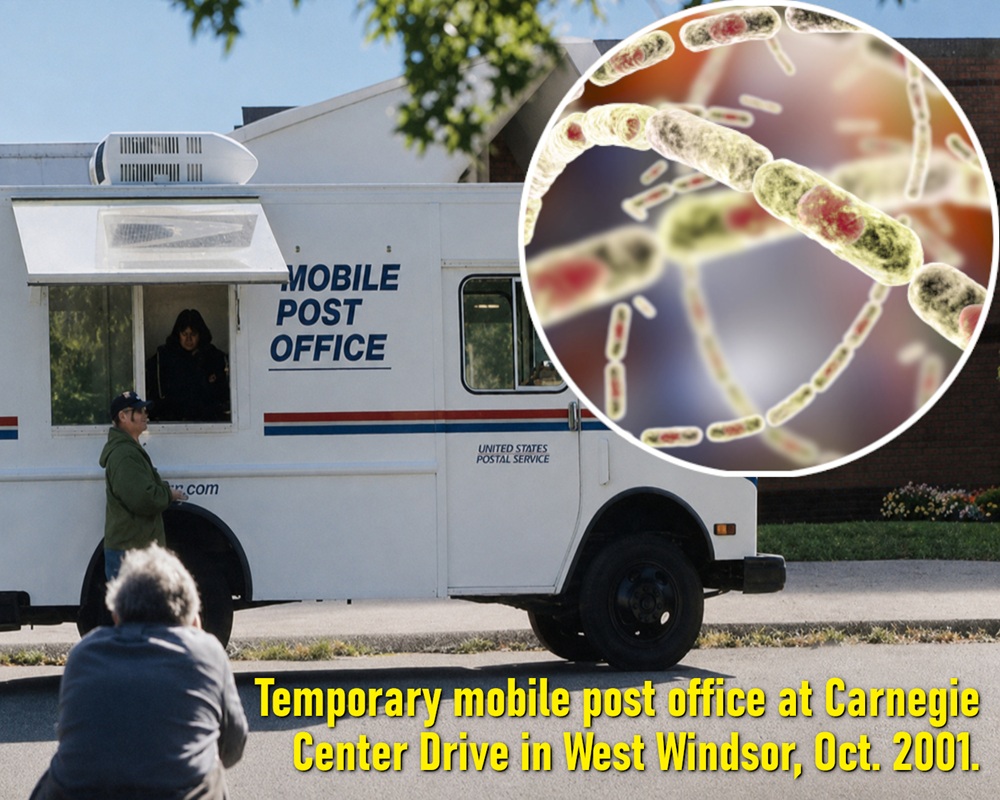
On Oct. 26, officials reported that a single colony of anthrax had been found at the “Princeton” Post Office at 213 Carnegie Center Drive, which, despite its name, is in West Windsor. They closed the facility that evening and shifted service outside while additional samples were taken. Tests ultimately showed there was no widespread contamination in the facility, and the building reopened Nov. 5. Officials concluded the colony was most likely due to cross-contamination from mail that had passed through Hamilton, not evidence that attack letters had been mailed to or from West Windsor.
Multiple other local postal sites, such as the Princeton Junction post office at 331 North Post Road, were tested or evaluated as the investigation widened. The Palmer Square post office at 20 Palmer Square in Princeton Borough later tested positive for a trace amount in a letter carrier case, but officials cleaned the area and kept the office open, judging risks to workers to be low. Investigators ultimately identified a street mailbox at 10 Nassau Street in Princeton as the source from which the attack letters were likely mailed.
Federal summaries later identified two processing centers as particularly heavily contaminated: Hamilton and Brentwood. Twenty-one other facilities experienced lesser levels of contamination in New York, Connecticut, Florida, North Carolina, New Jersey and Washington, D.C.
In the wake of the 9/11 attacks, the anthrax letters sparked further fear across the nation. Mercer County hazmat teams answered hundreds of calls about suspicious powders, and a Fleet Bank branch on Nassau Street in Princeton closed briefly after a white-powder scare that tested negative. Princeton University, local schools, banks, offices and the media reviewed mail-handling and security practices as bioterrorism became part of everyday public discourse. Nationally, the fear after Sept. 11 also had broader social consequences, such as inflaming harassment of and discrimination against Muslims, Sikhs, Arabs, South Asians and people perceived to belong to these groups.
The speed of cleanups depended on the level of contamination. The West Windsor post office, for instance, required targeted cleaning, follow-up sampling, temporary disruption and, ultimately, a quick return to service. In contrast, the Hamilton facility required a much longer remediation and renovation and did not reopen until March 2005. Brentwood also remained closed for years, while the Hart Senate Office Building in Washington, D.C., was fumigated with chlorine dioxide under federal oversight.
The federal investigation into the attacks gradually shifted from tracing mail routes to identifying who prepared and mailed the spores. In 2010, the Justice Department formally closed the case and concluded that Army scientist Bruce Ivins, who died by suicide in 2008, had acted alone. However, some scientists, journalists and former investigators have continued to question aspects of the evidence. Because Ivins died before any charges were filed or a trial could occur, the case was never tested in court.
The anthrax attacks, and the broader public discourse around terrorism, prompted the U.S. Postal Service to undertake many operational and technological changes, including routine screening for biological hazards, irradiation of government mail, revised ventilation, employee training and accelerated mail-tracking improvements.

