

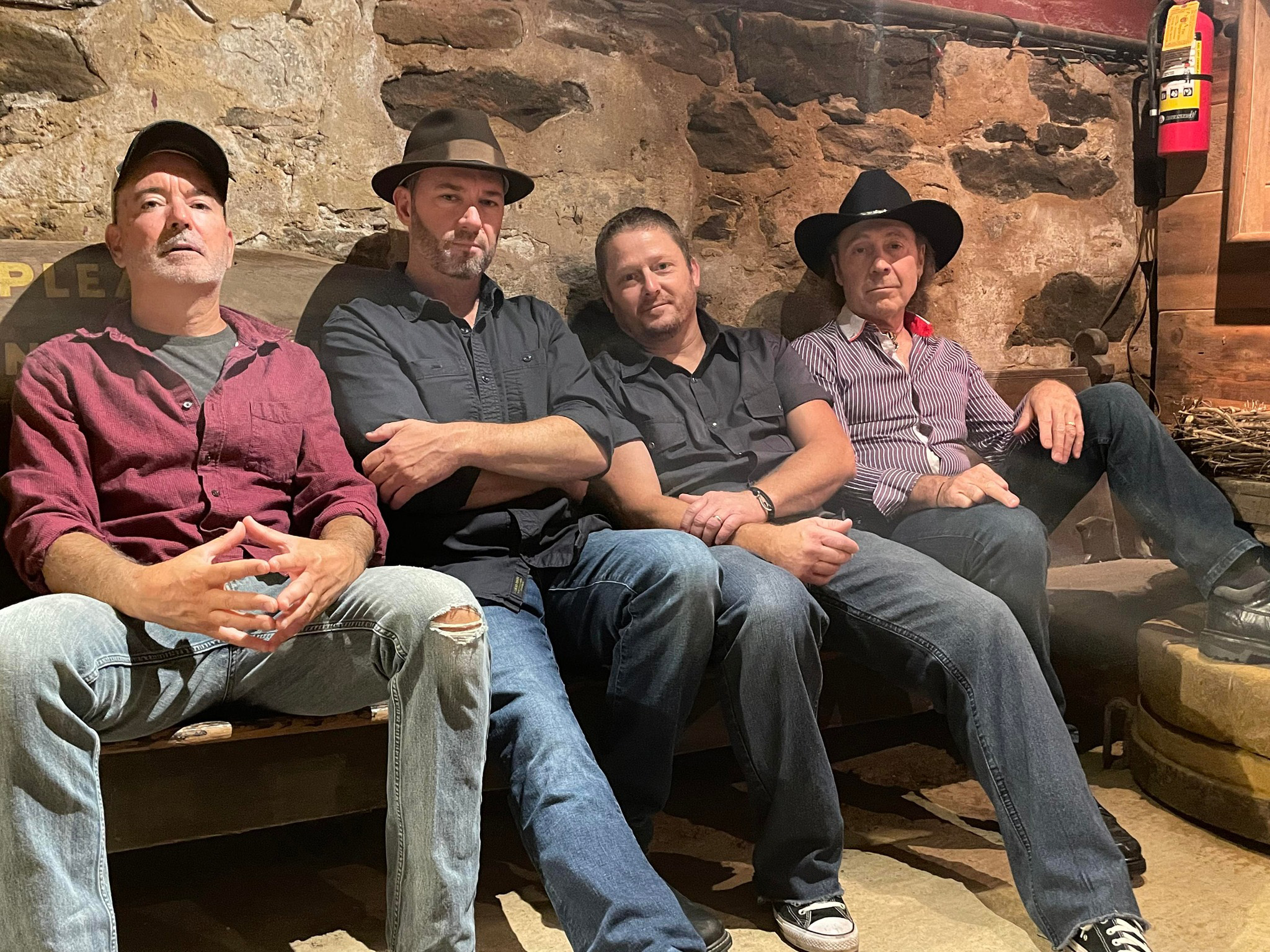
While the guys in the Successful Failures are steeped in real country, traditional classic folk songs, blues, bluegrass and Americana music, it is not quite right to characterize them as a roots music band.
To be sure, they play familiar and obscure chestnuts from Johnny Cash and Hank Williams, but they also celebrate the music of the Replacements, the Clash and even the Beatles when it is called for.
It all depends on the audience, explains guitarist and singer-songwriter Mick Chorba, whose “mostly” Americana-roots music band has gained a regional following during the past two decades.
Chorba, who was raised by supportive parents and sisters, said all he ever wanted to do was play music and be able to make a living at it.
Like many of the family farmers who are his neighbors in northern Burlington County, Chorba embraced “the lifestyle” years ago but needed to make a living in the meantime. Now a retired public school teacher, he has been able to prosper with his state teacher’s pension and the money he makes performing locally and on short tours with the Successful Failures.
The Successful Failures are scheduled to perform a free concert at 7 p.m. Saturday, Aug. 15, at Joseph Lawrence Park, 316 Ward Ave., Bordentown. For an updated performance schedule, visit thesuccessfulfailures.com.
The band has been performing local and regional engagements, traveling as far as Tennessee, for more than two decades. Its members are recording their 12th studio album, once again consisting mostly of original material.
The current band includes drummer Rob Martin, bassist Ron Bechamps and guitarist Pete Smith. Chorba sings and also plays guitar and harmonica.
Smith joined the group in 2014 after an earlier guitarist left to open a business. Chorba described Smith as an experienced touring musician who has performed internationally with Chubby Checker and Robert Hazard and the Heroes.
Asked to recall especially memorable appearances, Chorba immediately mentioned the Bristol Rhythm & Roots Reunion in Tennessee. The festival has featured national acts including Steve Earle, Josh Ritter, Jeff Tweedy, Deer Tick, J.D. McPherson, Lucinda Williams, Loretta Lynn and Hayes Carll.
As much as the Successful Failures enjoy performing for large festival audiences, its members also relish scaled-back, acoustically oriented appearances at smaller venues such as the Chesterfield Inn, the Record Collector in Bordentown and Tir na nOg in Trenton.
The group remains a fixture in the Mercer and Burlington County music scenes, performing at clubs, breweries, restaurants, record stores and community events.
The band’s eclecticism is a large part of what makes the Successful Failures distinctive.
“We will do something that sounds kind of punk rock, and then we’ll do something very traditional from Hank Williams,” Chorba said. “We love to be eclectic, and I love American music, so that includes blues and country as part of that. But our overall sound is the sound of a rock ’n’ roll band.”
The traditional country songs the group performs tend to come from an earlier era.
“When we play country, it’s usually Johnny Cash or Hank Williams or something very old and very traditional,” he said.
The Successful Failures average about 50 performances a year, which Chorba said is enough to keep the musicians busy.
“It’s good to have the safety net of my teacher’s pension because, like farming, it’s a very hard business,” he said.
Chorba and his bandmates have watched many performance venues open and close throughout New Jersey and eastern Pennsylvania. Those venues have included breweries and clubs of varying sizes along the Philadelphia-Trenton-Princeton-New Brunswick corridor.
As the musicians have gotten older, they have welcomed more opportunities to play afternoon and early-evening engagements.
The live-music landscape “is always changing, so we’re always trying to stay one step ahead and continue to evolve as needed to remain a viable live act,” Chorba said. “So we use our website and social media as needed. It’s another way to reach people.”
Although Chorba recognizes the need to maintain an online presence and answer emails, particularly when the band is touring in unfamiliar areas, he does not view streaming as an adequate substitute for performing before an audience.
“I don’t take any joy in singing a song into my phone or over the internet for people so they can sit in their house and watch,” he said. “I had to do that during the pandemic. I didn’t care for it. I kind of backed away from that.”
Successful Failures performances typically consist of about 80% original material and 20% cover songs, Chorba said. The ratio varies according to the venue and the band’s familiarity with the audience.
Following advice that folk-rock musician Richie Havens offered years ago, the group also sells its albums at live performances.
“A lot of the tunes we’re playing right now is stuff we recorded at Sun Studio in Memphis last year,” Chorba said. “We recorded a cover of ‘The Long Black Veil’ that has always been a favorite of mine.
“We’ve also been putting our stuff out on vinyl for the last eight years or so, and that’s been very interesting because people are still interested in buying vinyl LPs.”
Asked whether the group uses the vinyl pressing plant in Bordentown, Chorba said its production needs are not large enough to make that financially practical.
“We sell LPs in the hundreds, not the thousands, so we can’t afford them, although I did take a tour of the place with Randy Ellis,” he said.
The band traveled to Sun Studio in Memphis, Tennessee, in May 2025 to record new material. The trip also included performances in Bristol, Memphis and Knoxville, Tennessee, and Winston-Salem, North Carolina, as part of the group’s 20th-anniversary celebration.
“We recently recorded at Sun Studio in Memphis and released an EP last year from that session, and we’ve been blessed to be at it now for the better part of 22 years,” Chorba said.
The short tours have helped keep the experience fresh for the musicians.
“It’s really important to travel a couple of times a year. It keeps it fun,” Chorba said in a 2025 interview. “We do long weekend tours, play new venues, and it has helped to keep the band together.”
“It’s great to play places that haven’t seen us and heard the band before,” Bechamps said in the earlier interview. “If we get a handful of new fans along the way, it’s worth it.”
Touring has become easier as the members’ children have gotten older.
“For me, it was harder when my son was younger,” Chorba said in 2025. “It’s getting easier now because I’m not juggling as many things. Juggling your family and your job is tough.”
Bechamps agreed.
“There’s less coaching involved, so we can dedicate a little bit more time to the music,” he said. “And we’re doing it in such a way that it is never a drag.”
The Successful Failures grew out of Chorba’s earlier band, the Dipsomaniacs, which formed when he was coming out of high school.
Chorba grew up in Mercerville and developed his love of music as a student at Nottingham High School. A self-described “band kid,” he learned saxophone and piano before taking up guitar, which became his primary instrument.
He joined his first band as a teenager and went on to perform at regional venues including City Gardens in Trenton, the Rathskeller at Trenton State College and the Stone Pony in Asbury Park.
“Music was my identity as a kid,” Chorba said in the 2025 interview. “Everybody tries to find their drive. For me, it was playing music.”
Chorba’s earliest awareness of country music, blues and early rock ’n’ roll came when he found his father’s collection of 45 rpm records in a closet. He began listening closely to Elvis Presley, Bill Haley and His Comets and Hank Williams.
“I liked all of it,” he said.
After graduating from Trenton State College, now The College of New Jersey, Chorba and a high school friend became involved with the Dipsomaniacs, another Mercer County-based band.
After about 10 years with the group, Chorba began looking for musicians to help him record original songs that did not fit its sound.
“I’m a songwriter, and I had a bunch of stuff that didn’t seem to fit into the main band,” Chorba said in the earlier interview. “The Successful Failures started as a side project for material I wanted to try out with different people.”
Chorba contacted Bechamps, whom he had met through the regional music scene, and Martin, who had previously played with the Dipsomaniacs. The group released its self-titled debut album and gradually developed from a side project into Chorba’s primary musical outlet.
One factor behind the band’s longevity is that its members have shared similar goals while balancing music with careers and families.
“The band is the passion, and the job is the enabler,” Bechamps said in the 2025 interview. “You don’t want the music to turn into a job where it gets to be more of a hassle than a passion. It’s complete enjoyment rather than anything else.”
Bechamps grew up in Jackson and later settled in Robbinsville. A self-taught musician, he plays guitar, bass and mandolin. He works as a mechanical engineer in the telecommunications industry.
Chorba also spent much of the band’s history working outside music. He earned a master’s degree in English from Trenton State College in 1998 and taught English for 25 years at Northern Burlington Regional High School in Columbus.
“Primarily I’m a singer-songwriter, but then I went and got my master’s in English and worked for 25 years as an English teacher, and now I’m back to doing music again full time,” he said.
Chorba said having a career outside the band meant he did not have to depend on music to pay his mortgage.
“In some ways, it frees you up to follow your muse,” he said in the 2025 interview.
He considers himself fortunate to be able to devote more time to his primary passion at this stage of his life. It is something he had dreamed of doing since he was a young teenager.
“My hopes for a musical career haven’t changed,” Chorba said. “It was just something I always wanted to be doing, to be in the creative mode, playing shows, recording albums and working with other good musicians.”
Chorba’s background in literature has also shaped the band.
The Successful Failures took its name from a phrase Chorba found in “The Minions of Midas,” a Jack London short story.
“I’ve always written down things from books that I read and phrases that I like,” Chorba said from his home in Chesterfield.
In the earlier interview, he explained that he had kept a notebook of possible band names.
“The Successful Failures was one of them, and I had written a fictional story about a band with that name, so we chose it for the band,” he said.
Literature has influenced more than the group’s name. Chorba, the band’s principal lyricist, said works he encountered as an English major and later taught as an English teacher frequently find their way into his songs.
“A lot of my inspiration does come from literature,” he said in 2025. “A lot of historical fiction, American history, Shakespeare, and I like poetry, too. It will pop up in my songwriting without me necessarily intending it to.”
Songwriting remains a regular practice for Chorba. He jots ideas in notebooks, shares unfinished songs through his Substack newsletter and listens to other musicians for inspiration.
“Writing isn’t something that you can sit around and wait for,” Chorba said. “You just have to put in work, and there is a lot of satisfaction.”
He recalled a passage in Keith Richards’ memoir, “Life,” in which Richards described how writing songs with Mick Jagger changed the way they observed the world.
“Once Richards started writing songs, it changed the way he viewed the world,” Chorba said. “He paid attention to the way people said words, and I started doing the same thing, looking to the world for inspiration.”
Chorba has a recording studio in his home, giving the band easy access to a place to develop and record its music. The group has also worked at studios in Haddon Heights and Red Bank.
For a band with failure built into its name, the Successful Failures have put together a durable career. The group celebrated its 20th anniversary in March 2025 and has released 11 studio albums, recorded well over 100 original songs and performed in approximately 15 states.
The band’s eclecticism may make it difficult to categorize, but it has also allowed the musicians to continue following their interests rather than being tied to one narrowly defined sound.
“I feel like our trajectory is still on the incline,” Bechamps said in the 2025 interview. “We just keep getting better and better.”
I also shifted the anniversary statistics and Bechamps’ closing quote to the end, where they work better as a summation of the band’s history.

